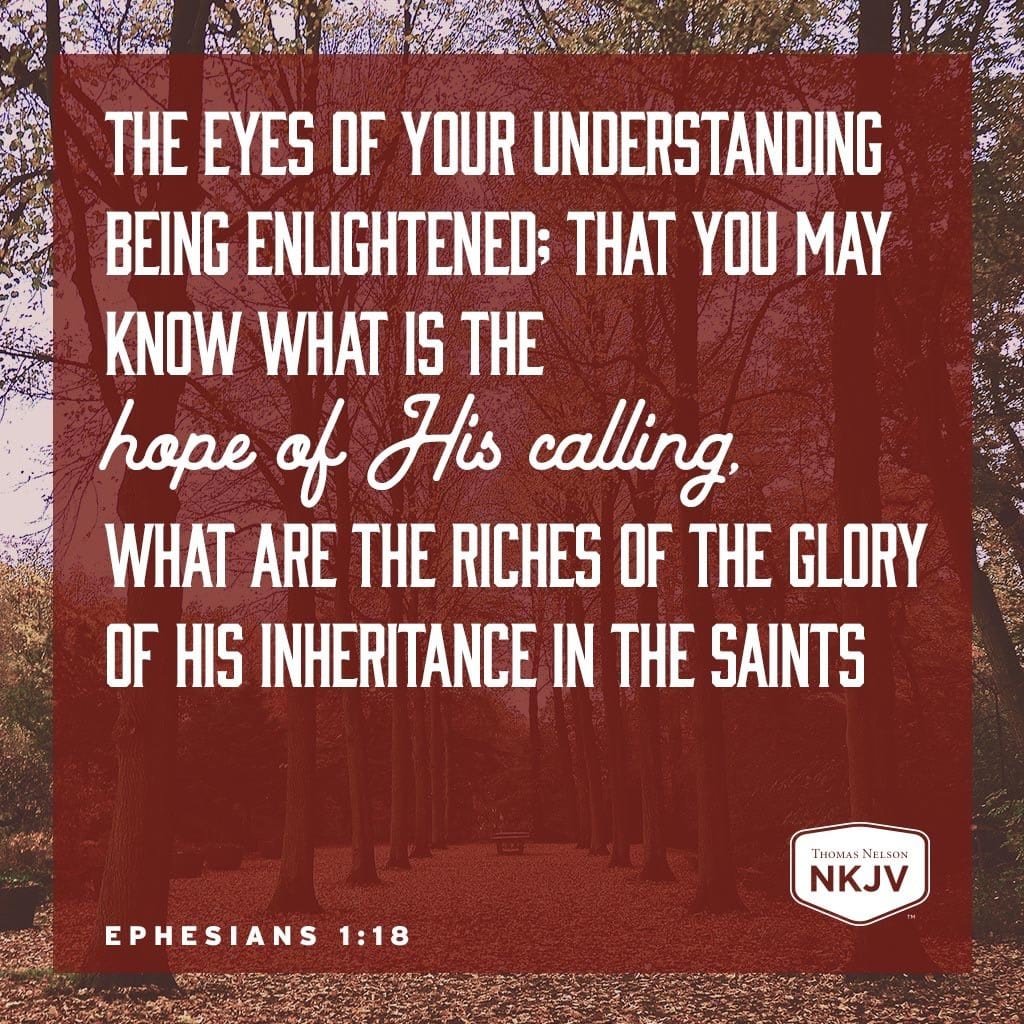
Have you ever read a verse that suddenly made you see the whole Bible differently? Recently, I was reading Paul’s prayer in Ephesians 1, where he asks that “the eyes of your understanding” would be enlightened. It struck me that this is the exact opposite of what happened back in Genesis 3. When Adam and Eve ate from the forbidden tree, “the eyes of both of them were opened”—but what they saw was shame, fear, and separation from Yehovah. Paul was praying for our eyes to be opened not to darkness, but to light, hope, and restoration.
That one contrast made me realize something: the good news is much bigger than the small version many of us grew up with. Yes, the good news includes forgiveness of sin through the death and resurrection of Yeshua the Messiah. That is precious and central—without His sacrifice, we would have no hope at all. But the Scriptures tell a story stretching from Genesis to Revelation that is far richer and more breathtaking than a “ticket to heaven.”
The more I read, the more I saw a pattern: if the bad news of Scripture is exile, then the good news must be God’s plan to gather and restore. When we see the good news only as forgiveness of sin, we have the door—but we’re missing the house. There is a whole beautiful story our Father has been writing since the beginning of time, and we are living in the middle of it.
Let’s start at the very beginning.
The Good News Begins in Genesis
The good news doesn’t begin in Matthew or Romans. If we really want to understand the scope of what Yehovah is doing, we have to start in Genesis, because that’s where we discover what was lost—and therefore, what must be restored.
In the Garden of Eden, we see Yehovah’s original design for humanity:
Relationship — Yehovah walked with Adam and Eve.
Identity — They were made in His image.
Purpose — To be fruitful, multiply, and rule the earth under His authority.
Shalom — A life of peace, wholeness, and blessing in Yehovah’s presence.
Then came the serpent’s lie, tempting Eve with the idea that she could find wisdom apart from Yehovah. The result was tragic:
“So when the woman saw that the tree was good for food, that it was pleasant to the eyes, and a tree desirable to make one wise, she took of its fruit and ate.”
(Genesis 3:6 NKJV)
Instead of gaining what they hoped, Adam and Eve were driven out of the garden—exiled from Yehovah God’s presence. This is the first exile, the root of all the others we read about later in Scripture.
If the first problem was exile, then the good news—the “good news” (Hebrew: בְּשׂוֹרָה, besorah)—must involve a way back.
And right there, in the middle of judgment, Yehovah spoke the first promise of restoration:
“And I will put enmity between you and the woman, and between your seed and her Seed; He shall bruise your head, and you shall bruise His heel.”
(Genesis 3:15 NKJV)
A Redeemer would come. A Seed would crush the serpent’s head. The story of Yehovah’s besorah begins here.
Yehovah’s Covenant with Abraham: The Seed of the Good News
The next major step in the story comes in Genesis 12, when Yehovah called Abram and made a stunning promise:
“I will make you a great nation; I will bless you and make your name great; and you shall be a blessing… and in you all the families of the earth shall be blessed.”
(Genesis 12:2–3 NKJV)
Here we see two key truths:
Yehovah would choose a specific people—Israel—through whom He would work.
His plan was never about blessing only one people, but about blessing all the families of the earth.
Abraham received a covenant of land, descendants, and blessing—but most importantly, a promise that through his Seed, all nations would be blessed. Paul later identifies that Seed as Messiah (Galatians 3:16).
From this point on, the besorah unfolds as the story of how Yehovah will restore relationship with humanity and bring blessing to all the nations—the “nations” (Hebrew: גּוֹיִם, goyim)—through Abraham’s family.
This is the foundation of the good news. It is not a “New Testament idea.” It was Yehovah’s intention from the beginning.
Israel’s Calling and the Tragedy of Exile
When Yehovah rescued Israel from Egypt, He wasn’t just freeing slaves—He was forming a people for Himself. At Mount Sinai, He revealed their identity and purpose:
“…you shall be to Me a kingdom of priests and a holy nation.”
(Exodus 19:6 NKJV)
Israel was called to be a light to the nations (Isaiah 49:6), showing the world what it looked like to live under Yehovah’s loving rule. If the nations were ever going to understand who the true God is, they needed a living example. Israel was chosen for a mission: to display Yehovah’s goodness to the world.
But like Adam and Eve, Israel chose disobedience. The warnings Yehovah gave through Moses came true: they would go into exile among the nations if they turned away from Him.
“And Yehovah will scatter you among the peoples, and you will be left few in number among the nations where Yehovah will drive you.”
(Deuteronomy 4:27 NKJV)
This scattering was not just a political crisis—it was a covenant consequence. Israel lost land, unity, temple, identity, and the blessing of dwelling in Yehovah’s presence. The condition of exile—distance from Yehovah—became the central problem of the Hebrew Scriptures.
And if exile is the problem, then simply “going to heaven when we die” cannot be the full solution. The Hebrew Scriptures cry out for restoration—not escape.
The Prophets Announce the Good News
When we turn to the prophets, we find that they consistently speak of a future restoration—a return from exile so great that it would make the first Exodus look small in comparison.
Isaiah uses the very word “good news” to describe this coming restoration of Yehovah’s people and the arrival of His kingdom:
“O Zion, you who bring good tidings,
Get up into the high mountain;
O Jerusalem, you who bring good tidings,
Lift up your voice with strength,
Lift it up, be not afraid;
Say to the cities of Judah, ‘Behold your God!’”
(Isaiah 40:9 NKJV)
This is the besorah:
Yehovah Himself returning as King, gathering His people, restoring them, and revealing His glory to the nations.
Isaiah 52 continues:
“How beautiful upon the mountains
Are the feet of him who brings good news,
Who proclaims peace,
Who brings glad tidings of good things,
Who proclaims salvation,
Who says to Zion, ‘Your God reigns!’”
(Isaiah 52:7 NKJV)
The good news according to the prophets includes:
Yehovah returning to reign
Israel being gathered from among the nations
Salvation, peace, and restored relationship
The nations coming to know Yehovah
The prophets did not separate personal salvation from national restoration or the redemption of all creation. They saw it as one unified act of Yehovah.
The good news is Yehovah bringing His scattered people home—and through them, blessing the whole world.
Yeshua the Messiah Continues This Same Story
By the time Yeshua the Messiah came, Israel had been scattered among the nations for centuries. Some had returned to the land, but the promises of full restoration had not yet been fulfilled. The prophets had spoken of a coming King, a Shepherd who would gather the lost sheep of Israel, renew the covenant, and bring the nations to worship Yehovah.
So when Yeshua began His ministry, it’s no surprise what message He preached:
“The time is fulfilled, and the kingdom of God is at hand. Repent, and believe in the gospel.”
(Mark 1:15 NKJV)
Many of us grew up hearing that “the gospel” was only about personal salvation from sin. But what “gospel” would Yeshua’s listeners have understood? They didn’t have centuries of Christian theologians to influence their perspective yet. They weren’t thinking about going to heaven when they died.
They were thinking about Isaiah’s promises—that Yehovah would return as King, gather His people, forgive their sins, and restore His kingdom over all the earth.
Yeshua came announcing that this good news was beginning.
He said His mission was:
“I was not sent except to the lost sheep of the house of Israel.”
(Matthew 15:24 NKJV)
He gathered disciples, healed the sick, set people free from spiritual bondage, and taught the ways of Yehovah’s kingdom. His miracles weren’t random acts of kindness—they were signs that the promised restoration had begun.
Through His death and resurrection, Yeshua dealt with the root problem behind every exile: sin. Sin separates. Sin scatters. Sin breaks covenant. Without forgiveness and new hearts, there can be no restoration.
His sacrifice opened the way home—not only for Israel, but for all who would come to Yehovah through Him.
The Nations Join the Covenant Through the Messiah
The prophets always said that when Yehovah restored Israel, the nations would come to know Him as well. This was not a new idea invented in the book of Acts. It was the fulfillment of the promise to Abraham: that all families of the earth would be blessed through his Seed.
Paul writes:
“That the blessing of Abraham might come upon the Gentiles in Messiah Yeshua, that we might receive the promise of the Spirit through faith.”
(Galatians 3:14 NKJV)
The good news is not that Gentiles replace Israel. The good news is that Gentiles are invited in—brought near to the covenants of promise through the Messiah.
Paul describes it beautifully:
“But now in Messiah Yeshua you who once were far off have been brought near by the blood of Messiah.”
(Ephesians 2:13 NKJV)
Brought near to what? He explains:
“…that at that time you were without Messiah, being aliens from the commonwealth of Israel and strangers from the covenants of promise…”
(Ephesians 2:12 NKJV)
The nations weren’t brought near to a new religion. They were grafted into an existing covenant people. The dividing wall came down so that Israel and the nations could worship Yehovah together.
This was never about replacing Israel—it was about expanding the family.
The Good News Isn’t Finished Yet
We often talk about the gospel as if it is something completed in the past. And in one sense, the victory is already won—Yeshua conquered sin and death, and He is seated at the right hand of the Father.
But the Scriptures also speak of a future fulfillment—a greater gathering still to come, when the restoration will be complete.
Yeshua spoke of it when He said:
“And He will send His angels with a great sound of a trumpet, and they will gather together His elect from the four winds, from one end of heaven to the other.”
(Matthew 24:31 NKJV)
Ezekiel saw it in a vision of dry bones coming to life—a picture of Israel restored into one people under one Shepherd.
Isaiah foresaw the nations streaming to Jerusalem to learn the ways of Yehovah. Zechariah saw all nations coming up year after year to worship the King. John saw a new heavens and new earth, with the New Jerusalem at the center and the tree of life healing the nations.
The good news is not only that Yeshua saves us from sin—it is that He is coming again to reign, to restore, to gather, and to make all things new.
We are living in the middle of the story. The gathering has begun, but it is not finished. The kingdom is here, yet still coming. Salvation is personal, but also national, global, and cosmic.
Why This Bigger Gospel Brings More Hope
Why does this matter? Why risk expanding the gospel, when the simple version seems easier?
Because the bigger gospel brings bigger hope.
If the gospel is only about forgiveness, we are left waiting for heaven.
But if the gospel is about restoration, we can live with purpose right now.
This bigger gospel tells us:
Yehovah keeps His promises—to Israel, and therefore to us.
We have a place in His family, His kingdom, and His story.
Our obedience matters, because it reflects the kingdom we belong to.
Our suffering is not the end—restoration is coming.
This vision turns our hearts toward hope. It fuels worship. It gives strength for trials. It shapes how we parent, how we build community, how we live our daily lives. It calls us to shine as a light to the nations as we wait for the return of our King.
The reduced version of the gospel can leave people forgiven, but unsure what to do next.
The full gospel calls us into a life of meaning—walking in the ways of Yehovah as citizens of His kingdom.
A Closing Encouragement
If you’ve ever felt like something was missing in the gospel you were taught, you are not alone. Many believers are sensing that Yehovah is opening our eyes to the fullness of His plan—not a new gospel, but the same good news proclaimed by the prophets, by Yeshua, and by the apostles.
It isn’t a smaller story about escaping earth. It is a glorious story about heaven and earth being reunited, Yehovah dwelling with His people again, and His kingdom filling the world with truth and peace.
The story began in a garden. It ends in a garden-city. And right now, we are living in the in-between—invited to join Yehovah in His work of gathering, restoring, and preparing for the return of our King.
“The eyes of your understanding being enlightened; that you may know what is the hope of His calling, what are the riches of the glory of His inheritance in the saints…” (Ephesians 1:18).
May your eyes be enlightened, not to shame and exile like in Genesis 3, but to the hope, calling, and inheritance we have in Messiah. May you find joy in seeing your place in Yehovah’s beautiful story.
He is gathering His people. He is redeeming the nations.
And we get to be part of it.

Unless otherwise noted, all Scripture in this blog post taken from the New King James Version®. Copyright © 1982 by Thomas Nelson. Used by permission. All rights reserved.

An encouraging message, Anne. Thank you.
Blessings & shalom.
Rachael