It’s been almost 2 years since I started wearing one-type-or-another of headcovering to church. As I originally wrote here on my blog, I did it because I was reading 1 Corinthians 11:1-16 and just couldn’t see any way around it.
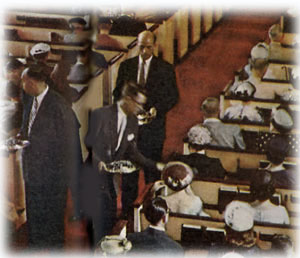
Women wearing headcoverings in 1948 – photo courtesy of Scroll Publishing
I don’t usually like to stir up too much controversy here on my blog, but being on bed rest has given me a little more time for reading and reflection. I was pondering why so few women wear any type of headcovering, even though most that I know claim to take the Bible literally. I’m not judging anyone! I honestly STILL don’t like wearing anything on my head. I feel so conspicuous! In fact, my headcovering is often a wide, cloth headband, which might not even look like a headcovering to anyone else. I’m starting to rethink that.
Therefore, in the hopes of stirring up some friendly controversy among my blogging and Facebook friends, I thought I’d bring up this issue again.
First, here is a list of posts and articles I’ve recently been reading:
- Why Headcovering Is for Today
- Head Coverings and the Body of Messiah
- The Biblical Headcovering (PDF)
- Those Headcoverings (an entire blog devoted to the subject)
- Headcovering – Not So Simple an Answer
- Changing Thoughts on Headcoverings
- Head Covering Through the Centuries
- Headcoverings – Yea or Nay? (with links to audio sermons near the top)
Secondly, I really would WELCOME comments — both from friends who DO cover (but I’m not trying to preach to the choir here), and more so from friends who do NOT cover (because I’d love to hear why). Yes, I know it’s controversial, but this is ME speaking. I promise not to bash you! Who knows… I might go into labor any day now and not even have time to answer a single comment. 🙂
Who’s brave enough to start the discussion? Why don’t women in our Bible-believing churches wear a headcovering?

P.S. Dear Facebook friends, would you mind clicking here to add comments on my blog rather than on my Facebook page? Thanks!

http://www.gty.org/Resources/Sermons/1844
This is a non-issue for me. But since you asked I thought I would share this as food for thought.
I do wear a head covering to church because, like you, I don’t see how I Cor. 11 teaches anything else. And my husband has asked me to as a symbol of submission. As to why women do not – some I think have never thought about it. Others find it so contrary to current culture that they think I Cor. 11 could not possibly mean someone should cover their head in church.
Kay Matson
Thanks, Missy. That was a very interesting sermon by John MacArthur. It is continued at http://www.gty.org/Resources/Sermons/1845. I think he contradicts himself a few times, trying so hard not to offend his large audience. (For instance, he says that a veil must be cultural because the Jewish men were covered when they prayed; but then, he says that Paul is telling the Jewish men they are wrong to cover.)
I agree with his conclusion that women’s hair should be longer than men’s hair. That issue alone is a tough one in our churches! So this was a good read. I just wish he had taken it to its logical conclusion, instead of insisting that the veil is cultural.
Thank you!
I read several of the articles and PDF with interest. I feel led to also wear the covering, but my husband had a rather “funny” and unhappy response to it. I will continue discussing it with him, wearing one around the house, and letting him see the Lord change me. I think he would be embarrassed if I wore it out of the house. I guess I will just have to wait for God to change both of us. 🙂
The passage clearly says to cover while praying or prophesying. It also is very clear that this covering he is referring to is different than the hair. He is speaking of a cloth covering. I think the basis of the passage is speaking of the line of authority and how it is “for the angels”, perhaps because they cannot read our hearts but they can see this outward sign of authority in the head covering. (This point throws out the whole “cultural” argument!)
For me it just comes down to the fact that the bible says to cover while praying or prophesying, so why shouldn’t I? I don’t think that means to even cover for the entire service, but I don’t have a problem with women doing that either. Then there are some who cover all the time because 1 Thes. 5:17 says to pray without ceasing, but I think that may be taken out of context a bit, and this passage says only while praying or prophesying.
Some people I know even apply “prophesying” to reading the Bible aloud. Prophesying is delivering a message from God, and reading the Bible is a message from God, so they believe it includes reading the Bible. I don’t think I would take it that far, but okay, I can see where they get that.
On a personal level, it keeps me from being vain!
I have been studying this for a while too! I think I am close to having the whole passage memorized! LOL!
I wear a headcovering for church and my devotions. and usually when I am going to pray (or others are praying) I will cover my head with my hand.
I am the only one I know who cover I just started last year. and years ago, I remember thinking “only mennonites cover – but I wonder why” of course not only mennonites cover, but that was I thought. And then I saw ladies wearing doilies the size of their barrettes (held on by a barrette) and I thought that is just weird -why do it if you don’t cover your head, but really why do it. Now years later (maybe 10) I cover and I use a doily for my private devotions (I can fold it to keep in my Bible with clippies attached). But basically, I applied human logic to a Biblical issue – so I didn’t cover because no one did or because this or because that or whatever. Now I cover after years of being directed to headcovering websites by accident and reading and rereading 1 Cor 11 – I couldn’t come up with a good reason not to (and I wanted to).
In public, I purposefully don’t wear a covering that looks like a religious covering of any type. II try to make sure they don’t look religious (usually scarves or wide headbands) because I don’t want people to think I am a super Christian (or a Muslim/jew depending on how I wear the scarves) or for them to think I am holier then thou etc – I don’t want them to think about me at all. 🙂
Oh and I wear a headcovering at the dentist because I do a lot of praying in that chair.:) (I am terrified of the dentist)
I’m Catholic so I wouldn’t say that I follow the Bible literally because Catholics aren’t taught to interpret the Bible to the letter. We do, however, have tradition. Before the 60s and Vatican II, all Catholics covered their head because it was tradition and part of the Bible. After Vatican II, the practice fell out of favor and there hasn’t been any real issue or statement from the Vatican to continue or discontinue the practice.
I started covering my head at Mass for two reasons. One: because I wanted to feel modest, which head covering is a sign of modesty, and that’s what I felt God called me to do (be modest but not necessarily to cover my head). Two: because when you visit with the Pope you cover your head, so I felt that this was a sign that it was still a part of tradition.
I know that you were more interested in why Christians choose to ignore or choose to follow the Corinthians verse. But I think that it applies to why some Catholics choose to follow tradition or not to. It’s all up to how you interpret something. Corinthians has been interpreted to mean long hair or modesty in general, and some take it more litterally. The same goes for tradition. Some think because there’s nothing official that you don’t have to that it’s “optional” and others like me feel that it’s not because of how you approach the Pope. I think that if the Pope told Catholics to wear a headcovering; women would again take up the practice (with some protest). And I think that some Christian groups (like Mennonites) require it and so those women follow. It’s all about who’s in charge and how they interpret the passage. Same goes for where and when you wear a headcovering. All the time, when you pray, or just at worship services. It’s all up to the person and what denomination or faith they follow.
Hope that helps.
I believe Paul is speaking primarily of modesty, and the submission to authority which is exhibited in modesty. I take him to mean that long hair is a woman’s glory and does not belong on public display. It is most appropriately either shorn or covered. But because cultural differences meant not every woman wore coverings all the time, he asked that at the very least, a woman should be covered when praying or prophesying in public (the context), so as to not draw the wrong attention to herself when she does so.
A contemporary comparison might be that a sleeveless top and thigh-length shorts aren’t considered immodest in our society. Even Christians who don’t wear them every day might slip them on to go swimming. But if you’re going to be speaking in church … could you please wear attire more befitting the activity, which doesn’t draw attention to your appearance and distract from what you’re saying?
I wear my hair pinned up whenever I’m in public, and even at home when I might be seen by men other than my husband. Though I’ll readily share why I believe a covering is appropriate, I don’t teach other women to wear a covering. Unless the Holy Spirit inspires her to do so, she’ll have difficulty at whatever point she must defend herself.
If forced to make a choice between pinning up my hair or wearing a covering which fails to conceal the glory of long hair, I’d forego the covering and pin up my hair. I see it as the more modest and less controversial compliance with the spirit rather than letter of what Paul teaches.
P.S. If I didn’t make it apparent, I do wear a covering—though with the opposite application of Kathryn Richards, above. My hair is ALWAYS covered in public, but not always at home, where I don’t feel the need to be as modest.
Like Deltaflute, I am Catholic… so insert her explanation from the first paragraph for part of this lol… but I have always heard that the covering verse was a cultural thing and not something that we HAVE to do now… but that we can follow it. As I’ve gotten older (not that I’m all that old I think lol) I’ve become more drawn to it. Am I covering in Mass? No. But I feel like I should, which probably means personally I should right? LOL Beyond that though, I also feel like I should full time… Not a typical Catholic thing, but I’m learning there are more of us out there that feel this way. Once again, I don’t… but… I do cover more often in general public than I do in Mass. For some reason (and I think it has a big part to do with just the particular Parish I’m at) I’m less comfortable doing so at Church than I am in regular public. Its something I need to work on.
Thanks to all of you for these heartfelt comments/teachings. I really appreciated the comments from Cindy – about WHEN to cover. I am studying to be baptized Orthodox and about half the women wear the covering and the other so not. Each has a sound, and “personal” reason for why or why not. When I am painting and writing, which is my work – I often wear my cowgirl hat – which is kind of my creativity uniform. I put it on and that is “WHAT” I am doing. I have not wanted to cover as I felt it was just one more thing women had to do to “cover” ourselves, and there has been quite a lot of that going on already in the spiritual and physical sense in the church. After reading this, and the wisdom of you ladies, I shall consider wearing one during prayer…which in the Orthodox Church is pretty much the whole time…but I know I cannot wear this raggedly old cowgirl hat or I would really be in trouble.
The other thing, is that since I love the Virgin Mary, and she almost always has one on, I will think of her and give it a try. Lord Have Mercy. Bless all of you.
You say you “love the Virgin Mary”. What about the Lord Jesus Christ, who suffered horribly,and died for your sins, so that you can have eternal life?? Mary is dead and buried, and will arise with the rest of us on Judgment Day. She was not a virgin after Jesus was born-He had brothers and sisters! She is not watching over you or anything else. We have ONE Mediator between God and man, and that is Jesus Christ, our Savior and Redeemer. Worship HIM, not Mary!
Amen!!! To Him ALONE be the glory!!
We are not to worship Mary since that would be idolatrous.
We are to worship only Jesus(Yahshua).
John 14:6 praise Yahshua for truth!
I do cover and I appreciate this post.
I have one comment – if the passage is only cultural – why do men always remove their hats during prayer and church? Because the bible teaches that men are not to pray with their head covered. This is still practiced today and would be considered disrespectful if not done.
I believe the modern feminist movement is the cause of women no longer covering their heads in church. Before the turn of the 20th century – this was a none issue.
I cover all of my hair, but I do not go to church.. (Looking for “The Church” not the building).. I do believe a biblical woman should cover her hair, and all that stuff, but I also realize the Spirit and His will…. I personally wear a Princess Hijab style.. I personally do not desire not care about the opinions of others… I honestly do delight in Modesty… But for me it is a personal choice…. My desire is to my husband as Torah states…. What other women do… not my authority… Other then if we have nothing in common…. I will tend quietly to my work… Thank you…
When we try to bind “our beliefs” on other people then we are guilty of making laws for God, and God did not make it a commandment that women who do not wear a covering cannot come to church. If this passage meant that you cannot be a Godly woman without covering your head, then what we are doing is binding “laws/commandments” where God did not give a law or commandment. If you want to take this passage and say yes you must cover your head to be Godly, then you will have to change many of the passages in the Bible to fit what you believe. In summary, covering your head to go to worship is an old issue that has been around a long time, and the same arguments are made over and over again for this. If you want to cover your head, then do so. I can be just as Godly and submissive to my God, and my husband even without hair and no covering. And God will allow that and love me for it too.
It is certainly not an issue of you can’t come to church if you’re not wearing a covering. We are made pure and holy by Jesus’ blood. That is how we are justified, not by anything we do.
Having said that, once we are saved God begins to work out that salvation in our lives. Those things don’t make us more Christian – the thief on the cross never did any good works, but he still went to heaven justified. But bit by bit the Spirit convicts us of things we need to change. If a person has not received personal conviction on a particular issue, maybe God is still working them through it. But once you have understood a passage of Scripture, and continue fighting it, you have a problem.
I find it surpising that so few Christian women wear headcoverings. But what I find really disturbing is that the issue is never even talked about. It is simply assumed that the practice is not for today and no further questions are asked.
It might help if sometimes pastors preached on the subject instead of just skipping to the bit about the Lord’s Supper.
I dont wear a cover (as yet) although i am leaning towards or being more convinced that it should be done , in a time of prayer prophesying (publicly) ie in church for the church. I dont think it is an issue of being more godly with or without it. I think its a matter of doing it because of “the angels” as the scripture says. And if God through the scriptures says we should for that reason, then I guess we should, whether we fully understand its significance or not. At time of writing I havent read all the article links. Just talking of my own personal studies in times past on those verses of scripture. I like one of the coments of wearing a covering that doesnt look like a delibrate HOLYReligious prop on the head (me paraphrasing).
Dear Anne. I think it is a shame more Christians do not support head coverings. Fashion concerns and peer pressure to conform are probably the biggest reasons women don’t. Add to this the pressures of women in the work place and dress codes. I think it is a shame we as Christians find ourselves conforming to the standards of non-Christians. It’s as if many of the foundational truths that were in the early church were scattered like pieces of a puzzle and we are left trying to find all the pieces to fit them back together again. Paul said that when he left “grievous wolves would come in not sparing the flock.” I want to encourage you to continue on your quest for the truth in this area as God will bless it.
“Why don’t women in our Bible-believing churches wear a headcovering?”
Because we have conformed to the world rather than been transformed by the Word. Our desire to fit in with the culture was/is stronger than our desire to line up under what God said is the physical sign that we unreservedly agree with the order of authority that He has put in place.
And now that all that is in the past, we have the dilemma-“but if we do it NOW, then we are calling attention to ourselves. Can’t the sign change with the culture?”
I pray earnestly about this matter. I consider it a spice tithe-not something to be left undone while focusing on the weightier matters. If this passage were preached in our churches, even in all it’s many current interpretations, I think we would see more women covering.
I do think that Eph 5:22-‘as to the Lord’, and Numbers 30 show us that wives are in a unique position before God and should wait for their husband’s leading and approval.
Holly,
I really like how you brought up Numbers 30 with this topic. That was helpful!
All of you,
I’m sorry for not responding to each of you personally. I’ve so much enjoyed your comments, and I hope you keep it up. A friend recently said to me,
“God was pretty clear in 1 Cor 11. If I know He said this, and I understand that He said this, and I am capable of doing this, then I have to obey…anything less than immediate cheerful obedience is willful disobedience, aka sin. If I told my daughter to do something, and she heard me, understood me, and knew how to do what I told her to do, I would expect nothing less from her. How much more so when the one giving the instructing is GOD, and the one receiving the instruction is a grown adult?”
Good, huh?
Hugs to all,
~Anne
I am so glad to have found this! This is a subject no one seems to want to talk about. I grew up in a very Biblical church, but when this subject came up I was told it “didn’t apply” to us now. That seemed strange to me since they were teaching me to follow the Bible in everything, but it wasn’t until long after I was married that I finally began obeying this. I’ve been wearing a head covering for almost 20 years, and I am the only one covered at church or Bible study, so I feel a little odd sometimes, but I have also gradually seen the blessings in my life, marriage, and the attitude of my sons toward obeying the Bible fully, so I am glad I obeyed. We don’t usually know why we have to obey until after we do it, after all. I sometimes wear a hat, but usually wear a lace covering, sort of like a scarf, I think some people call it a mantilla. I wear one at home when I pray, too, usually a bandanna type scarf. It might seem unimportant, I suppose, but if we won’t obey Him in the little things, are we really trusting Him? He loves us and has reasons for what He asks us to do. Thank you for your witness.
So this is probably an odd answer for you.
I’m a Quaker, but not of the Christian variety (no, belief in a separate deity-being is not a requirement of Quakerism; belief in the Spirit within all people is sufficient…Quakers can reinterpret or disregard the Bible as the Spirit leads…highly individual), and not of the plain-dressed variety either. However, I do often wear a snood (a crocheted hair net). I don’t do this consistently, wearing it probably about half the time (though I’ve had my snood on four days in a row now).
I’m not sure why exactly I wear it. I like how it looks, yes, but I think modesty is a factor as well. I’m also someone who wears skirts below the knee every day (yes, in winter too). I find that the perception of religiosity means men are less likely to make lewd remarks or catcall. While I don’t believe that the onus should be on the woman to make herself less attractive (ie. men can and should control themselves), I like avoiding street harassment.
I suppose it comes out to being an outward sign of a modest lifestyle.
In all fairness and an attempt to be objective, here as an article I recently read, stating that Christian women do NOT need to cover their heads:
http://www.shepherdsfellowship.org/Comments.aspx?Post=4544
Hmmm… watcha think?
~Anne
What about verse 15 that says “But if a woman have long hair, it is a glory to her: for her hair is given her for a covering.” Does that not show that it is the hair that is the covering? Seems like God is saying that a woman ought to have long hair and not be shorn or shaven in the way that a man would be, because that hair was given to her for a covering. I am a Missionary Baptist and we’ve looked at this in bible studies occasionally. It’s one I am going to study out some more, though.
Another writer says,
Paul said that men should not cover/katakalupto (Strong’s 2619) their heads. And in verse 11 Paul contrasts that with: “Judge in yourselves: is it comely that a woman pray unto God uncovered/akatakaluptos/?” (Strong’s 177) Note that ‘uncovered’/akatakaluptos is the opposite of ‘to cover’/katakalupto. Katakaluptos basically means to UNcover or UNveil. So far, we have a ‘men uncover, women cover’ command. Now for where the confusion comes in: When Paul refers to a woman’s natural hair covering, he uses an altogether different word: “But if a woman have long hair, it is a glory to her: for her hair is given her for a covering/peribolaion.” (Strong’s 4018). Peribolaion means something thrown around (loose items like a veil, a mantle, a vesture). Hair is more like a glorious decoration given to woman. Now if Paul had meant the naturally occurring hair covering and the headship-type covering to be one and the same, he would have used the same word for each. Instead, a woman’s natural hair covering (peribolaion) is being contrasted to this other covering (katakalupto) that women wear. In fact, the katakalupto actually *covers* the peribolaion.
http://www.lightofmashiach.org/women/headcovering.html
This is how I’ve heard it explained, but I’m happy to discuss this further. 🙂
Hugs,
~Anne
Hi, I stumbled accross this blog when blog-surfing, and I’m glad I did. The past few months I’ve felt led to investigate this passage. I feel convicted to cover. After reading and studying this with my husband, we came to the conclusion that the headcovering meant was provided for us in the form of long hair, and that it was a verse supporting a woman having long hair rather than a veil, as the hair is a natural veil. Just as men are frowned upon for growing long hair as they should be unveiled. My husband seems reluctant at the idea of me wearing a covering, and feels the bible is only speaking of my long hair.
However, God still seems to be bringing these passages to my attention, hence the fact I somehow stumbled upon this subject in one form or another every day since speaking with him about it. So if you believe it dosen’t translate as the hair, why do you believe that, and can you give me a resource to show him so we can open this subject back up for study. I’m about to look at the link provided above, but I can find little else. Any websites I find simply quote the verses, and leave it at that, but in it’s current english translation at any rate (I have looked through multiple english translations) I don’t see any way around the idea that the veil spoken of is the hair.
Also the comment about the angels not knowing our hearts, and that’s why the veil is nececary is interesting. Do you have any more insight as to the part of the angels in that verse? It confused us altogether.
Look at the headcovering movement website and
Peaceful wife website.
Although I don’t go along with all their doctrine.
The headcovering subject is well covered,with scriptures, language lessons and historical references.
Praise Yahshua for the truth!
I have so enjoyed reading these posts. I am a traditional Catholic and I have covered for Mass and for private prayer since I was quite little. It has just been the done thing for me, but I am so interested in how it seems to be geting more popular. I am also thrilled at seeing younger people also comign to veiling. It fills my spirit with hope. God Bless you all
How does nature show you that it’s a shame for a man to have long hair? It keeps growing until men cut it. God Himself commanded those who took the Nazarite vow not to cut their hair (both men and women) and both men and women shaved their heads afterwards (with no shame)
I would suggest to you that Paul is addressing a cultural issue that is not applicable for us because having shorn hair no longer means that one is a prostitute as it did in Paul’s day. For a more scholarly look at this issue see
1 CORINTHIANS 11
Transcription from a message й 2006 Cheryl Schatz
http://webcache.googleusercontent.com/search?q=cache:Xz2G7c-TyN8J:www.2x2church.com/1CORINTHIANS11.doc+cheryl+schatz+head+coverings&cd=5&hl=en&ct=clnk&gl=us
Hi! Found your blog while looking for opinions on headcoverings. I really enjoy reading people’s reasonings for and against.
At 18, I became a Christian and joined my then-boyfriend-now-Dear-Husband at his family’s church. It supports headcoverings, though less and less women wear them regularly, and I am one of the few under the age of 50 who wear a covering of any sort (usually a pashmina in the winter and a lighter scarf in the summer). DH’s Mum & Grandmother both wear a beret, which made covering less unusual for me, but I didn’t start until after my research on the topic convinced me that Paul was definitely talking about cloth headcoverings during public worship.
DH and I recently relocated, and now attend a church which doesn’t wear coverings (though one tiny old widower still wears a hat). Sometimes I feel a wee bit conspicuous (particularly if I need to readjust my scarf), but never embarrassed, nor ashamed. I know I’m honouring my Husband, and giving glory to God when I cover my head, so the act doesn’t bother me, I just don’t want to draw attention to myself when the focus should be on God.
The subject of headcoverings recently came up during a young adult Bible study, as an aside during a discussion on legalism… regarding how some Christians go so far as to ban all dancing, drinking, playing cards, & watching movies, and some even require *gasp* headcoverings. Thankfully, the main study had been completed, because at this point, the group discussion turned into a 2 person debate. Only the leader and I had studied 1Cor11 at any length, and he only knew what he’d been told by his professors (obviously from the anti-headcovering camp).
Basically, the thinking is that Paul’s teaching here is A) cultural (something to do with Greek prostitutes) and B) referring to “long hair pinned up,” so even if it wasn’t a cultural command, there would still be no reason to use a cloth covering (I completely disagree with this interpretation of the Greek ‘katakalupto’, as do most Bible scholars & translators). Therefore, this passage isn’t spoken of anymore; my generation isn’t even aware that it’s an issue. Indeed, many of the young women seemed surprised that I had a Biblical foundation for wearing a scarf during worship.
Now, I don’t mind voicing my interpretation of Scripture, but I have a hard time telling someone what they *should* be doing (speck/log/white-washed tomb concerns, aye?), and here’s where it got dicey… The passage also speaks about hair length, so I was asked if I thought all women should have long hair (including the older women with the permed clouds), and all men should have short hair. Well, the passage clearly states that even nature teaches us that what is a glory to one is a shame to the other. I don’t want to make hair length or headcoverings a salvation issue, but at the very least they are on the same level as modest attire, since the consequence of neglecting each is shame. So I carefully asked “If the Bible tells us we should be doing something, what do we do about it?” Uncomfortable shrugs all around…
I then asked “If you believe this passage is referring to ‘long hair pinned up,’ are you encouraging women to do so? Because this passage is obviously teaching that *something* has to be done with regards to hair, gender & worship.”
“Well, no…”
“And if a Christian man kept his hat on during service, would the Elders or Deacons say something to him?”
“Well, yes, because it’s a cultural thing.”
But that culture is dictated by this passage!
Anyway, to answer your question, I think most churches don’t want to offend women, so they have reinterpreted scripture to agree with modern feminist thinking. They seem to realize their new interpretation stands on shaky ground, so they avoid teaching on the passage altogether. In my experience, the newer generation doesn’t wear headcoverings because, rather than making a conscious, informed decision against it, they are simply ignorant that the issue even exists. Ironic considering 50 years ago headcoverings were a non-issue because everyone knew what 1Cor11 taught.
Elaine,
This is such an excellent comment. Thank you! I really agree with you, and I’m so glad you took the time to write this out for all of us.
May I ask a practical question? What is a “pashmina”? (You mentioned that you wear one in the winter.) Also, what style of scarf do you wear in the summer (size, shape, how do you tie it?). Finally, do you wear a covering only during worship, or do you wear one daily?
Thank you!!! I really appreciate it.
Hi Anne,
I wear a covering during Lord’s Day worship service. I’ve considered wearing one full time, but since it’s not commanded (elsewear Paul speaks of not focusing on extravagant hairstyles [braids], but doesn’t mention covering hair outside of worship) and my Husband isn’t a huge fan of the idea, I decided not to. However, I do find covering during private prayer helps me stay on task. As a Protestant, we don’t use many rituals or idols/icons to help us focus; covering tells my mind “It’s time to dwell on God now.”
I’ve tried wearing several different types of scarves, bandanas and headbands, but most styles look silly on me (I find they don’t cover enough of my hair, anyway), and they usually slip off my straight hair. I’ve used bobby pins pushed through side french braids to hold scarves on, but I needed something which didn’t require forethought, and could be thrown on or off easily.
I’ve settled on using long rectangular scarves (with fringe at the ends), simply draped over my head with the ends hanging loose in front, or one end loosely thrown over my shoulder. They generally stay in place, look more feminine than bandanas, cover most of your hair, come in a wide variety of colours, patterns & fabrics, are fairly common, reasonably priced, and can serve other purposes. The ‘pashmina’ I mentioned earlier is a long, wide scarf made with a thin, warm material (usually a wool blend). I love it because it’s so practical, serving as both hat & scarf in our cold, windy northern winters.
http://www.amazon.com/Elegant-Jacquard-Weave-Pashmina-Shawl/dp/B001GNILKQ/ref=pd_sbs_a_6
http://www.amazon.com/Ladies-Viscose-Lightweight-Summer-Scarf/dp/B0039LNMXY/ref=sr_1_116?ie=UTF8&s=apparel&qid=1275602240&sr=1-116
I just happened to see this subject…I have been covering for several years now. Just like you, Anne, every time I would read I Cor. 11, I could not get around the straightforward reading of the passage! I had heard the different ways to explain it away, but being honest, I could not accept what I had heard. I began by wearing a hat to church. Over time, we came out of the church and are now Torah observant believers in Yeshua/Jesus. Not long after that occurred, I began to feel I was to cover at home also. We came across a booklet by a Torah teacher about the subject. After reading it, I asked my hubby to read it and tell me what he thought I ought to do. I would go by what he said…after he read it, he told me he thought I should cover.
One of the interesting things about this passage, which I could never understand was the part about the angels. An explanation that finally made sense to me was that this is referring to fallen angels. Back in Gen. 6, many people believe that “sons of God” is referring to fallen angels. They co-habited with human women according to this line of thinking. There are extra-Biblical books that say the same. (Enoch, etc.) Anyway, according to this perspective, what we do in the physical effects things in the spiritual…it is a protection from spirit beings who mean us harm. Don’t necessarily want to get into a debate about this…just thought I’d share.
Hi there,
I’m your new ‘friend’ who has recently written inquiring about your Bible curriculum, including if it is double sided :). My online name is different so wanted to point that out (who I am). Anyway, I don’t cover because my husband doesn’t want me to. He feels it was cultural at the time, and I can agree with that. A feminist movement was happening during that time (when coverings and hair length are mentioned) and my understanding is that if a woman was to cut her hair, she may as well have shaved her head–both were a disgrace. So a woman was to cover as a symbol of her submission to her husband. When I read the verses it sounds as though long hair is enough of a covering. I believe God is concerned with us as woman adorning ourselves with a meek, submissive attitude, and that is what He looks upon–not the often too easy to appear holy externals. If I were to cover, it would be all the time, not just in church. The one time I did cover and my dh approved was after the turncoat Democrat Stupak acted against his own bill to prevent abortion funding being written into the “healthcare” bill. Watching that was so disgusting to me, I was heartbroken for about a week and felt I needed the extra symbolism of Who my authority is in this life. I don’t personally see much point in only covering at certain times–thought it does give credit to my premise that it is not something required but is merely a preference. In our culture, long hair seems to be sufficient, but maybe that is just in my house LOL. 🙂
You have some good points Ann..Covering is not just in a church thing.. If one Covers it should be in the home, Driving..And so forth… I pray every where…. I believe GOD is very concerned about us obeying the word…. If I thought my hair was just my Covering, That would be enough for me as well…. But I just can not see this view… It says the hair was given for a covering, Not that it is the Covering…. I have been Covering for 21 Years now…. And I am not Amish or Such… It is so easy for so many women to see that the Amish Cover. But when others find out I am not Amish.. They just do not understand… It says Every Woman.. Not just one set…… That is you , And Me….. And I have no clue why so many think that it was just for something way back… There is no way this can be true… Women prayed way back then.. And they still pray today.. It says every woman that prays.. Not every woman way back then…So clear…
I truly do believe that many bible believing women dont cover because they dont know. I have been a christian for 22yrs. I love Jesus and I am passionate about Gods word. Amazingly and thankfully the Holy Spirit revealed 1 Cor11 (I have read many times before but leaders kept telling me it was for that time, I took what they said and believed it). He would not let go of me, so I studied. Frankly I was really looking for articles that agreed with me that it was a cultural thing and only for that time. And I did find articles that did agree with me. However, Our incredible Father continued to convict me. So I put aside all commentary and articles and studied and prayed for myself. Bottome line – I am covering. Gods word is clear and if we as daughters of the King will get alone with Him and really study with open hearts He will reveal Truth to us. So now I have peace through my obedience. Why do I cover? Because God says so, I want to show my submission to my husband, I want to constantly be in an attitude of prayer and because of the angels.
God Bless all my Sisters
The thing I find most interesting about the whole headcovering issue is how hard people work to explain it away. To me, it is rather simple–the Bible does say it, and no one with half a brain can dispute that. We take so many other things at face value, never questioning them–why is THIS the thing that must be changed and spiritualized and culturalized? I mean, when we’re told to partake of the Lord’s body and blood, we pretty much just accept that, right? And that is a WHOLE lot more difficult to understand than the simple “Let a woman be veiled while praying or prophesying.” The only part that is cryptic about the whole passage is the “because of the angels” bit.
And the fact that our entire culture has rebelled against this once nearly universal practice makes me very curious as to why such a simple thing has come under attack. It makes me even more intrigued–is there perhaps a whole lot more to it than we can really understand?
I think it is easier to understand this passage if we put the word “veil” where it speaks of the one cover and cover where it speaks of the natural cover (the hair) Anne explained it well #24. I do not think this is a take it or leave it matter. Paul is very emphatic in verse 6, and I have no doubt what people then thought of a shaved head on a woman. I think it is important that something is worn that is set apart from a weather garb because of the phrase “power on her head” which also makes it important to wear it most of the time. This tends to also make it an “order” veil, and helps women to keep their proper place. And although it’s purpose is not to start a conversation, it has certainly been a door opener in the lives of my wife and girls.
Has any one thougt of the covering as spiritualy covering. I male am spiritualy under ( covered) by christ therefore in that context my wife is covered by me in the sence of her spirituality. She should have my blessing or direction when teaching or praying etc. The head covering is only mentioned once in the gosples and other commands are backed up at least twice Peter and Paul address how not to wear the hair 1Timothy 2:9 & Peter 3:3 not braided with gold or pearls. Would it matter if covering was phyisical. God is very specific in his commands such as building the Ark and the Ark of the Covenant wouldnt he specify what type and how a covering should ne worn or fashioned? The third verse lays out the spiritual order for the church god christ man then woman. I believe this is basis to refere to the covering as spiritual. If womens long hair is her glory would god command it covered? Remember this little light of mine, why ” cover” it I’m gonna let it shine. Just my thoughts thanks.
I was also thinking, that covering the hair, is a symbol of covering the glory of man:
For a man indeed ought not to cover his head, forasmuch as he is the image and glory of God: but the woman is the glory of the man. 8For the man is not of the woman; but the woman of the man. 9Neither was the man created for the woman; but the woman for the manFor this cause ought the woman to have power on her head because of the angels.
By her covering her glory, (naturally).. which is also herself (the glory of man). She is showing that the glory of man ought to be covered in the presence of God glory (symbolisms for the benefit of the angels) real ones or possibly angels might refer to pastors… which again is a sign of honor submission to Gods order in the church…maybe)
sorry forgot to add that the reason why i say Pastors or Angles. Is because in the book of revelation it says for eg “Unto the angel of the church of Ephesus write;….”
So since the letter is for real people, a real church and its leader. the leader\pastor seems to be called “angel”
In my experience there is a practical reason for what the Bible teaches us. We can argue til we are blue in the face, but let me pose a few questions… If a young Christian woman who starts out her life with Christ wearing miniskirts, and plunging necklines, because she hasn’t yet learned about modesty, and then an older lady teaches her about headcovering, and she tries it, what do you thing could be a response? I would say sensuous clothing and headcovering don’t mix, and even the babiest of Christians could feel the tension. It seems like covering you head makes you want to cover the rest of you too.
Another thought is this–when you see Mennonites/Amish in their garb, you know exactly why, right? I mean, we know these people are not aethiests, right? Most, even the most cynical agnostic knows that Mennonites wear head coverings because of their “religion” (use that term loosely). Do we set ourselves apart in this way? Not to be holier than thou, but show that we live by a different set of standards than the world? Not to mention the opportunities it can open up for evangelism( “Don’t you feel oppressed? yada yada yada).
If nothing else, and you still feel foolish, are we able to feel a little foolish for Christ? Can we trust Him even when we feel foolish, knowing that we may reap blessings we never imagined? On the flip side of that, how often do we break a commandment or teaching we know about and claim, and don’t feel foolish at all? (when we should!) Talk about hypocritical… And me too, for I don’t even wear one! (though I have considered it).
Stuff to think on
Hi! Another thought, really quick. If I spend many days with my long hair in a braid, and then all of sudden leave it brushed and down, and go into public, I feel almost immodest. Back in those days, and even now, many (most, even) men prefer the beauty of long hair to short. I wonder if the head covering was also a way to keep a very sensual, beautiful aspect of a wife/woman under wraps, so that only her husband could enjoy it down. This would be a very distinct way of preserving their intimacy, and holding other men’s eyes at bay.
hmmmmmm
I agree, Laura! To john bigham’s thoughts- I think the reason the headcovering is only mentioned once in the Bible is because it was a common custom then that everyone knew what he was speaking of. The Corinthian culture was a very corrupt one and quite possibly the women were as those in our society who wish to be free to do as they please with their bodies/beauty. Check the size of Ruth’s veil in the book of Ruth. I won’t give you the exact reference but just look to find how much grain Boaz put in it. 🙂
I have been Covering for 22 years now, Covering is still for today, As long as women still pray, Women are to still cover, We all know that it could not be that just women prayed back then, And not today?
http://www.facebook.com/pages/Modest-dresses-HeadCovering-Shop/152327098138820?ref=ts
I’m wondering two things. If a woman wore some sort of mantle or long cloth daily as a regular part of her outfit, and left it down around her shoulders while at home or among friends (casual time), and pulled it up in company or in public (a more formal or “distant” time), is it possible that that’s the sort of thing the scripture is talking about? That, although she’s among friends during “church” time, her purpose in this time is more formal and so the mantle should be pulled up.
The second thing is how this fits in with no longer being under any compulsion to live one way or another. Romans 14 speaks much of how one person holds very strong beliefs about this thing or that thing, while to another all things are gifts from God. If someone finds it offensive for me to worship/pray/prophesy with my head uncovered, then when I am with them I will cover so as not to offend (just as I would not offer wine to someone who found drinking offensive).
My own personal convictions (outside of Jesus being the only way to God and Jesus’ command to “love your neighbor.. love God with all your heart…”) are my own personal convictions; everything else is simply the “flavor” I prefer. If someone is convicted to cover their hair, then she should cover; but what is it to me? Do I answer to her husband or to God on her behalf?
I do believe that issues of modesty CAN be cultural issues. For example, there are tribes in Africa where the women do not cover their breasts; they simply are not noticed as anything more noteworthy than a hand. However, covering them is considered IMMODEST as it draws attention to them. Modesty in the Middle East (where most of the New Testament came from, remember) might involve covering the ENTIRE head (including the face since it’s attached!). When Paul speaks of covering the head, why not cover the entire head (after all, if the head is cut off, it’s from the chin up..)?
I think we often misunderstand this idea of no longer being under compulsion to live one way or another. It doesn’t mean there is no standard of right and wrong. We are no longer held accountable to Jewish law, like the sacrifices and so on, but God’s moral standards still apply. People can get offended by all sorts of things, and it’s important to explain humbly why we believe as we do. And of course certain things are just the “flavor”, totally up to personal choice, like what music we like to sing. But if the Scripture teaches something, we ought to do it. Being set free from sin doesn’t mean we get to do as we like. We are slaves to Christ! There is no neutral ground – we either are living to please ourselves or to please Christ.
I’m not suggesting that anyone should act in a judgmental way towards others – we are supposed to counsel each other gently, and bear with weaker brothers and sisters. But I feel very strongly that it is a mistake to dismiss some of these issues as simply a matter of preference.
Shalom Anne,
Thanks for all the effort you put into your blog. I really enjoy it and have learned a lot from it!
Here is my view on Head covering: http://www.setapartpeople.com/to-cover-or-not-to-cover-head-covering-is-it-for-women-in-this-day-and-age
Shalom
Elsa
I became convicted to cover before my 13th birthday, but it quickly wasn’t working out. For now I’m experimenting with just covering during church or prayer services.
Shalom Anne,
You have asked me regarding head covering and I have written a follow up article on the topic. You may find it at http://www.setapartpeople.com/head-covering-questions-and-thoughts
I hope it helps. I find it to be a fascinating topic. Please give me feedback!
Shalom
Elsa
I found some great comfortable headcoverings at http://
http://www.millineryshop.net
At our worship meetings and Bible study, we don’t have to wear a head covering unless we would serve in a capacity normally held by a man, ie. if a woman was translating or signing for the elder preaching or praying, or if there was a group of all women and one is acting as a leader and praying. But in our last written information (organization-wide), it was left that you basically couldn’t go wrong by choosing to wear a head covering, especially if you were unsure. As a single woman, I thought that if I was married I would probably choose to wear one, because I figure I would pray for my husband (both in and out of his presence), though I didn’t think of what if he didn’t care for it. I think something like a snood wouldn’t stick out too much, but would look like I meant to do it as opposed to a bandana, which I associate with covering for a task (like painting) or I didn’t get my hair done. African-american women tend to wear more hats than others (historically and culturally), but usually it is limited to special occasions.
I like what someone else said above that it reminded them to be conscious about their prayer time and be modest. I also never thought of the protection aspect. At this point I’m undecided, but I don’t criticize anyone that chooses to use one.
I’ve been covering for about a year now. God convicted me and my husband that it was the right thing to do. I fought against it until my hair started falling out (“For if the woman be not covered, let her also be shorn: but if it be a shame for a woman to be shorn or shaven, let her be covered.”), and then I conceded defeat and wore my covering. I personally wear it all the time, because I am extremely disorganised, so it’s easier to know that my covering is already on my head, instead of having to root around in my bag or something for it!
I don’t think the 1 Corinthians 11 passage makes the covering about modesty as such, in the sense of sexual purity. It seems to me that the focus is more like, if a woman covers her head when she prays and prophesys, she is reflecting the created order, which in turn is a sign of submitting to God and His design for her life. Plus the things about the angels, which I do *not* get 🙁
This is all brand new to me, or should I say my obedience to it! About two years ago the Father began steering me in this direction. I can’t say I ever fought it. I just wanted to make sure I was doing it for the right reasons. My husband allowed it saying that if God told me to do it, I better obey. However, he wasn’t fully convinced it was biblical, but he never pressed in to find out if it was either.
So, here I am, two years later, he and I are both convinced that it is biblical. I am having a harder time with it than he is! I asked him the other day what we will do when going to the next Annual Business Gathering his job always hosts. Without flinching, he said, “We will go and you will wear it. No big deal.” I have a couple of months to prepare for that one! 🙂
A couple of points that some may want to Selah…
1) If a woman’s hair is her covering and she is to pray covered, and a man is to pray uncovered, then wouldn’t that mean that all men praying should be bald?? 🙂
2) If a woman’s hair is her glory, and all of us were primping, fluffing and spraying for our glory to shine, would we then be competing with the One who says, “I will share My glory with no one.”??, and finally,
3) If this is just a “cultural” issue, then I suppose we should all be wearing tatoos, piercings, skinny jeans, and cleavage-bearing-skin-tight shirts, all of which (except the tatoos) I had proudly worn and blended in with the rest of “culture” for the last 50 years of my life.
I here repented for this and I thank ABBA for His mercy, forgiveness and now GRACE extended to me to walk out in this messed up culture driven world a set-apartness that certainly stands out and gets noticed!
My mother asked me the other day, “Who will you reach for Jesus looking like that?” To which I replied, “I don’t know, Mom, but all I know is this is what God has called me to do, and in obeying I know He will be glorified.”
Thanks for letting me ramble on YOUR blog 🙂
Thank you for sharing your thoughts. You can ramble all you want to!
Dear Anne,
Hi, there! I read this article a few years ago, and it made an impression on me, though I didn’t actually DO anything about it (too embarrassed to step out against the masses). I have always thought that the Bible mandated hair coverings for women, but since it is not done commonly nowadays, I just had to… ignore that part and keep reading. Then, a couple of months ago, my husband was studying 1 Corinthians, and he turned to me and said, “Hon, I really think the Bible it teaching head coverings for women. Would you mind trying it?” I was rather shell-shocked, but I said okay! And it’s great! So much fun, and I really do think that it is biblical – though without my husband’s prodding, I never would have had the guts to do it.
Here are a few points:
(1) None of the arguments in 1 Cor 11 have ANY cultural connotations, or possibility of cultural connotations. Those arguments, frankly, seem just an easy out for looking to dismiss the passage.
(2) In almost all historical Christian societies, including worship services in the U.S. through the middle part of the last century, women wore some sort of head covering. Look at pics of Puritans, or Medieval Christians, etc. It was just part of the modest wardrobe! It is only in the 20th century that we have said (as we have said about SO many other issues), “Generations and centuries of thinking Christians have concluded X, but we uber-smart Christians in the 20th century have found out that everyone else through antiquity was wrong, and what is culturally popular now is what the Bible really says!” In other words, we look for any excuse to follow the crowd.
(3) Almost all biblical mandates have an inner and an outer commandment. Conversion – an inner heart change, followed by a public profession through baptism. Modesty – a heart attitude, accompanied by modest clothing. Etc. Both components are important.
Anyhow, thank you for bringing this to my attention! I probably would have been much more resistant to my husband’s suggestion had I not been mulling on your article for the past few years and already experienced a heart change in this area. I hope that more women come to this conclusion in the Christian church through the coming years!
Sincerely Yours,
Diana
1. Those who say that the covering in question and the shaving of the hair was cultural in Corinth does not know the history of that place. Those temples where women shaved their hair was destroyed long before this letter was written. Modesty was not exactly the norm there when this letter was written.. On the contrary, there had been a sexual revolution in Corinth about 30 years earlier. It´s the most similar to the recent sexual revolution known in history. Ever wondered why those letters contain so much instructions to stay sexually pure? Women in Corinth at Rauls time wore clothes and hairstyles to get sexual attention, joined in politics with rather feministic views and even used contraceptives for the sake of sex outside of marriage. Rauls message was not that they should BLEND IN with the crowd to be modest, but that they must be SET-APART from their hedonistic society to be modest. He could might aswell have been writing these letters to us, because similarities are so big when it comes to sexual morals.
2. Those who say that the covering in question was just cultural in his own culture and Raul was not inspired, only talking from his own perspective need to remember he used to be persecuting christians. Then he turned into suddenly completely leave his culture and all he had known behind to become the most persecuted christian himself! You don´t do that if you are not inspired and only care about what people of your culture think. The same goes for Mary and all the other first christian women who was also persecuted for their faith while wearing those coverings. If it was just some unimportant law of the jews then OFFCOURSE they would have taken them off. They where all spreading the message to leave behind all cultural practices. THESE PEOPLE WHO BELIVE IT WAS JUST CULTURAL ALSO NEED TO WAKE UP AND REMEMBER THAT THEY ARE ALSO LIVING IN A WORDLY CULTURE AND NOT ANY CULTURE. WOMEN NOT WEARING ANY HEADCOVERING IS ACTUALLY CULTURAL IN THE MOST SATANIC CULTURE OF ALL TIMES. We where surely warned that Satan would have the most power in the end-times.
3. There is actually this strange new teaching that the hair of a woman IS the covering in question. I´ve even heard people convinced that putting up the hair is a sin(!) Some belive a womans hair need to be let-out to “cover” her properly. Firstly, hair obviously does not cover, since it easily blows around and exposes the scalp and neck! Secondly, the passage clearly states that a man is the image and glory of the most high and a woman is the glory of man -NOT of the most high. When it also says a womans long hair is her glory and it has been given to her for a covering.. People should understand her hair is the glory of mankind. For thousands of years everyone also understood this to mean she should obviously put up her own glory to give glory to the most high. Until the very end-time when some people got deceived enough to belive a woman should “cover” WITH her own glory -in other words show off her glory-to bring glory to the most high. I seriously belive this has something to do with people being brainwashed by disney-movies from an early age. The idéa of the long hair of a woman AS a veil reminds me of myself and others being totally obsessed with growing out long hair and wearing it let-out like disney princesses when I was a little girl. I thought that when I would be grown up my glorious hair would reach very long, just like theirs and I would always show it off. Little did I know that I would come to wear it up and cover it.
4. Some people argue that Raul was talking nonsense, because if a man ought not to wear ANY covering on his head, he could not pray in cold climate. A woman who had studied the original languages for herself told me that Katakalupto was a cultural Israelite word that included the words for head, long/draping and a garment that goes down from. (A word the Israelites used for the garment in front of their tent-openings.) I am pretty positive that Raul was reffering to a specific sort of covering/cloth. The not dressing like the opposite gender actually makes sense then. Because back then all men and women wore long, modest gowns. They should have been looking similar from a long distance if the headcoverings was of the same sort.
5. Some say that we should not wear the original type of covering (the garment/veil) because then we will look like muslims. Firstly, we should not care about how we look to deceived people, only how we look to the most high. Secondly, wearing the covering with a very visable cross is a good way to show others that not only muslims are wearing it. The first muslim women-previously pagan- where told to “extend their headcoverings” so that they would be recognized as beliving women. In other words to copy the style beliving women at that time wore. It really does annoy me when muslims think that the veil is a symbol of Islam, when it´s only a copy and the only reason it is seen as their symbol is the fact that most other women stopped wearing it. When you think about it this happened very recently. There are still a few old christian women who wears the headscarf in what´s now called “muslim style” where I live. I also wear this style, however I always wear a cross as a hair-slide on the garment so that none would mistake me for being muslim.
I don’t wear a cross because it’s idolatrous.
We are to worship Yahshua not what He was tortured with.
Besides He was not crucified on a cross it was a pole just like the one that had the bronze snake attached to it in the old testament.Which was destroyed by Hezekiah because the Israelites began to worship it.
We as Christians should not wear such things.
The fruit of our conversion should be seen in what we do,how we talk ,and by the modesty the Bible says we should have.
I don’t have to wear a necklace with a cross on it to show I am a Christ follower.
But I do need to wear a headcovering because the scriptures command it.
Praise Yahshua for truth!
Thank-you for your input, Veiled. It has helped me see more clearly.
Hi there, I have recently come back to my Catholic roots and head-covering came up. I have bought a Mantilla which quite frankly still scares me a bit. But the idea of covering my head as a sign of freely submitting to my husband’s and God’s authority, as well as a sign of wanting to humble myself freely and gladly is something that resonates within me.
I am kind of scared but should my fear of what people may think of me stop me from covering my head? I spoke to my hubby and he simply said that he would not make me do one thing or the other, just that I should follow my conscience.
I have a question. What about women currently with short hair. Should they cover? Do they have to grow out their hair?
Hi Anne,
I came across your website while reviewing the book “Telling God’s Story.” I completely agree with your review of his material and was pleased to see you post that. While searching around your site I also found your article on headcovering. This is a subject my husband and I have studied and examined very intently and believe that Paul’s command/instructions were never meant to be followed only by 1st century Corinth. I did not always believe this way however, and was raised believing that this passage was meant only for the Corinthian church and that Paul had given only this church these instructions. I never questioned that concept and quite frankly, I’m ashamed to say that I never studied this passage my whole life as a Christian. It wasn’t until I was questioned, and asked to give a reason why I didn’t cover my head, that I realized, I didn’t have any solid biblical or historical proof for my beliefs. Here is what our studies have revealed: Paul was giving a universal and age-lasting command for the Christian dispensation that never once had a cultural reason attached to it (headship, creation, angels). These are sacred and age-lasting reasons that are still in affect today and culture does not change that. Paul uses these same age-lasting reasons for women not taking a leadership role in the assembly in 1 Tim. 2:11 and 1 Cor. 14:34. This scale of authority is Paul’s main reason and in verse 10 he says, “For this reason a woman ought to have a symbol of authority on her head.” No culture, just plain sacred and divine reasoning. Paul appeals to our logic and common sense when referring to what is shameful and also to the nature of men and women’s hair length. He asks them to “judge among yourselves” if it was proper for women to be uncovered while praying and prophesying and completes his rational in verse 16 when he explains that ALL the churches were doing the same thing. From the very beginning of Paul’s letter he is preaching about unity and one doctrine. Why would Paul give this ONE church divine and sacred reasoning for following his instruction on headcovering and then turn around and tell only this congregation that they didn’t have to really follow this instruction, even though all the churches of God were following it. It just doesn’t make sense. I never picked up on it’s absurdity before, because I had never studied it. I’m convinced that is why most do not head cover today. They simply have not taken the time to give this an unbiased and honest study and are too influence by modern society. I was guilty of relying on oral tradition or articulation and “felt” that those who said such things knew what they were talking about. How wrong I was, and I was ashamed for not studying this sooner. Thankfully we were granted the time to mature more and study more and to see the scriptures for what they said and not for what we had been told. Anyway, thank you for your webisite.
Hi Anne,
My husband and I worked on a study guide for 1 Corinthians 11 and here are many of the resources we used.
~Mandy
HEAD COVERING RECOURCES
1. Head Cover Database By: Aaron Purvis
2. A Sign of Authority By: Wayne Jackson (Christiancourier.com)
3. The Head Covering of 1 Corinthians By: Paul K. Williams (You can download a PDF copy of this book or purchase one from this website) http://headcoverings.org/
4. No More Excuses! By: A. A. Bieler http://headcoverings.org/files/Christian-Head- Covering.pdf
5. No Such Custom- An Exposition of 1 Corinthians 11:2-16 By: Bruce Terry
http://www.ovc.edu/terry/articles/headcovr.htm
6. Postures in Prayer- Part 2- Covering the Head By: David L. Franklin
http://biblestudies- dlf.com/Topics/Postures%20in%20Prayer.dlf.pdf
7. In Christ – Neither Male nor Female By: Wayne Jackson
https://www.christiancourier.com/articles/1397-in-christ-neither-male-nor-female
8. Simply Bible By: Ron Graham
Church of Christ,
P.O. Box 897,
Childers Qld 4660, Australia
EMAIL: ron@simplybible.com http://www.simplybible.com.au/f982.htm
9. Airport Church of Christ Audio Downloads
http://airportcoc.org/
December 2005 Issues and Answers By: Wayne Jackson
Questions & Answers 1~ Head-Cover question begins at minute 21:50
10. Wallingford Church of Christ
1 Corinthians 11:2-16 Analyzed (audio lesson) By: Patrick Berlinger
1213 OLD COLONY ROAD – WALLINGFORD, CT http://www.wallingfordchurch.com/?s=head+covering
11. Command or Custom? By: Hiram O. Hutto
http://lavistachurchofchrist.org/LVanswers/2003/2003-10-01.htm
12. The Message of 1 Corinthians 11 By: Ethan R. Longhenry
http://lavistachurchofchrist.org/LVarticles/TheMessageofICorinthians11.htm
13. The Woman’s Headcovering, By: Michael Marlowe
http://www.bible-researcher.com/headcoverings.html
14. An Exposition of 1 Corinthains 11:2-16 The Head Covering By: Peter Ditzel
http://www.wordofhisgrace.org/headcovering1.html
15. A Verse by Verse Study of 1 Corinthians 11:1-16 By: Carrol R. Sutton
http://www.religiousinstructor.com/covering/verse.pdf
16. What does Church History Teach? By: Greg Price
http://www.albatrus.org/english/living/modesty/headcoverings_in_scripture.htm
17. Corinth, Coins and the Cult of Aphrodite-
http://www.forumancientcoins.com/Articles/aphrodite.pdf
18. AnIntroductiontoFirstCenturyCorinth-http://mychristianchronicle.com/2012/02/01/an- introduction-to-first-century-corinth/
19. Myths about the Headcovering By: Myron Horst
http://www.biblicalresearchreports.com/headcoveringmyths.php
20. The Christian Woman’s Headcovering: The Style and How Much Should It
Cover? By: Myron Horst http://www.biblicalresearchreports.com/headcoveringstyle.php
21. Command or Culture – Discerning the Difference By: Wayne Jackson
https://www.christiancourier.com/articles/1050-command-or-culture-discerning-the- difference and The Classification of Bible Commands By: Wayne Jackson https://www.christiancourier.com/articles/109-the-classification-of-bible-commands
22. 1 Corinthians 11:3 & 15:28 – Paul Sends His Greetings By: Wayne Jackson
https://www.christiancourier.com/articles/574-1-corinthians-11-3-15-28-paul-sends-his- greetings
23. Anointing with Oil – James 5:14 By: Wayne Jackson https://www.christiancourier.com/articles/118-anointing-with-oil-james-5-14
24. Did Jesus Institute Ceremonial “Feet-Washing”? By Wayne Jackson https://www.christiancourier.com/articles/796-did-jesus-institute-ceremonial-feet-washing
25. Are Christians Required to “Lift Up Holy Hands”? By Wayne Jackson https://www.christiancourier.com/articles/1093-are-christians-required-to-lift-up-holy-hands
Getting in on this discussion a little late… I’ve been covering my head for about 25 yeas now. Strictly according to what I found in scripture, although I did receive encouragement from the conservative flow of the late ’80s. The way I figure is that there are quite a few verses surrounding this notion in 1 Cor., some of them rather mysterious, so enough devoted to lead me to feel it’s important in some manner. Also, it seems to make such a big difference to other people, so controversial among some, that if a small piece of fabric placed just so is such a big deal, there must be something to it’s significance. Look at how people dress today, wearing anything (or not) that they want, and they receive little attention. But place a scrap of fabric or lace on your head… it’s something to think about.
I was always taught the 1 Corinthians 11 passage was cultural. But In 2008 just couldn’t convince myself it was cultural even though that was what I would have preferred. I ordered some head coverings and wore them only at home when I prayed. Since I didn’t feel any different or anymore powerful in prayer (not that our obedience should ever be based on feelings), I chose to put them aside until last year. Again I was convicted. I have been wearing a wide headband when I pray (church, home, car, etc.). I didn’t want to call a lot of attention to myself or make anyone feel I considered myself more holy so I choose wide headbands for now. I know of no one else that covers at my church other than two elderly ladies that wear hats every Sunday. I still struggle putting it on at times but I am determined. The warfare can be intense which makes me wonder just how significant a head covering might be. Sometimes it’s amazing the freedom that I feel once the covering is in place. And even though it’s just a headband I get some stares. I lead a small ladies group on Wednesday evenings and I cover for this too. This can be harder than on Sunday mornings. But it does seem that women who need ministry are more drawn to me than they used to be. I’m not saying that they are necessarily more drawn to me than someone who does not cover.
For me I do believe The Lord is growing me in humility. I know I struggle with pride. He is teaching me the beauty of humility. Also it has been my prayer for years that the men of God in our churches and in our homes would rise up and lead. Women outnumber men in so many churches and it seems almost like we’ve castrated them in their leadership. It’s not that women can’t lead or that we can’t do it well. It’s about remaining in the positions and under the authority The Lord has chosen for us. The book of Jude has some sterns warnings on this.
It’s amazing to see (online) that so many women are being convicted to obey this Scripture. Usually they are complying simply out of conviction and obedience to our Father and not usually to man. I’ve had 3 pastors try to convince me that covering is not for today. I almost decided I was off the hook after one I really respect talked to me and told me I might make other women uncomfortable. But The Lord quickly brought me back. It seems most of the testimonies I read come from women in churches where few, if any, other women cover.
Here are some of my challenges and I would so appreciate hearing from others of you on this. I struggle with women that believe any position a man can hold in the church a woman can also hold. My church does not teach this, but it has come to my attention that our women’s ministry team does not agree with the position of our elders. They say they submit to the elders but do not agree with them. This really bothers me. It bothers me that we have no women leading other women in our church that support the elders (and Biblical) position. I don’t know if the elders are aware or not and I REALLY do not want to stir up trouble. There seem to be so few women that do agree with the elders position in the congregation. Understand that I am not in a church that does not value women. They do! I know most of you understand what I mean. Sorry to ramble.
This issue of veiling/covering has been something I have pondered for a very long time. Recently I started head covering but I am finding it a real battle to do so in my emotions/spirit. I feel a real pressure to conform and I feel incredibly conspicuous when I go about my day.
The thing about praying/prophecy is that we are called to pray without ceasing…
To don a doily once a week seems kind of hypocritical to me. You are not doing it to be seen of man, that is one thing I’m sure of. Also in biblical days it was common practice to wear a head covering if you were a pious/modest woman. In particular in Jewish culture (of which Christianity is a part) they wore them once married. It was a sign one was married, where the wedding ring is an invention of a pope as the symbol of marriage
Why do people not cover? A few reasons: It feels weird and people want to blend in with society. No one else is doing it. Teachers aren’t teaching it or try to say that it was contextual to that culture such as men wearing effeminate head coverings etc. Because we can’t understand Paul’s reasoning: Where does he get the idea that head coverings mean something? Etc.
My thoughts as a Christian who believes that we should be following the Torah (law of Moses) in the way that Yeshua (Jesus) demonstrated, through the power of the indwelling holy spirit (contrasted with the oral law, Jewish traditions passed down which contradict God’s law) my thoughts go to the Torah to ask where Paul got his reasoning.
The first mention of veiling is Rebecca. When she was betrothed and brought back to marry Isaac she did not veil during the journey but when she saw Isaac. It is easy to see the parallel between Messiah and the believers (the Bride) in the story of Isaac and Rebecca. Where else do we see someone veiling themselves? Moses veiled himself after seeing the glory of God.
So could it be that she veiled herself as a symbol then and there: Her action prophetically foreshadowing the heavenly marriage?
Secondly, in the law of the woman suspected of adultery, she was to be brought before the high priest (so again, this represents the Bride and the High Priest in the order of Melchizedek, JC). She was to have her head uncovered/untwisted as a part of this ceremony, which implies that as a general rule, women who were married wore head coverings in public. While it has been debated if the Hebrew word for untwist refers to hair or veils, it remains a fact that women of that time are well documented historically to have worn head coverings, especially twisted ones (a tichel in modern Yiddish).
Throughout the bible well Israel went into captivity there were a few consequences they were to go through which are described as “shame” and “nakedness.”
Uncovering of the buttocks.
Revealing the leg (for women).
Removing of the veil.
Shaving of the head.
So going off all of these passages in scripture we can understand how the bible could have informed his view. He knew the Tanakh off by heart being one of, if not THE top scholar of Israel trained under Gamaliel. It can be hard to understand Paul because of this education. Peter warns it is easy to misconstrue him to the error of lawlessness (2 Peter 3, Matt 5).
There is the issue of the angels in Corinthians. Could it be that we have more spiritual authority when head covering. Something with men covering their heads I have to point out is that Jesus wore a tallit, a four cornered garment with tassels on the corners (the woman with a flow grasped, and also the play on words when he raised the little girl saying “Talitha cumi” as the Jews believed that when Elijah raised the little boy he laid his tallit over him with the tassels in his hand) Paul also was a maker of tents – probably tallits. These were called “little tents” in Hebrew, and where would he have gotten the time to do an apprenticeship in Bedouin tent making while studying full time in the school of Hillel? It was either study Torah or do an apprenticeship. But the making of tallis would have fit well with his skill set. The idea of the tzit tzit tassels was to remind to obey the Torah. The idea of wrapping it over your head and around your body like a big hug is a symbol of being wrapped in God’s Word.
It was a camel hair mantel/tallit which Elijah wore and passed on to Elisha. Tradition holds that this was then kept in the temple for the re-coming of Elijah. Finally we see it reappear when John the Baptist was found wearing the camel hair garment. Interesting as his father was a priest in the temple and we all know the supernatural story of his being struck dumb etc.
Anyway, I just want to add that I feel like I am really struggling with head covering at the moment. Even though I think they are beautiful, dignified, regal, modest, womanly, a sign of authority through submission to the truth etc, it is HARD to be conspicuous and I think also the enemy may have a direct agenda against this practise because he knows what it symbolises.
One last thing, the bible says that Yeshua will give us a “beautiful head covering” in exchange for ashes. The word for “head covering” here (translated “garland” in the KJV) is actually a “turban” in Hebrew – a twisted head covering.
Shalom and God bless you.
Paul links the spiritual principle of headship to the practice of covering. The question then is that if the practice should be considered Catholic (universal) to every woman married and unmarried, why is the principle not Catholic, unless anyone can show me where the headship principle applies outside marriage (that is to an unmarried woman). If the practice is for every woman for all time, might we infer that Paul is saying that the head of every woman is a man (whether or not he’s the woman’s husband). We know this is not Paul’s inference and the practice is not limited to married woman alone.
I believe then that these questions are easily answered if Paul is here referring to a practice that is customarily recognized. A daughter should be covered in public whilst still under her father’s roof and a wife should be covered in public whilst still in her husband’s house and this form of decorum which is the already established practice should be maintained in ministration (prayer or prophecy). These practices would indicate the principle of a woman submitting her liberty to be unveiled as this defies cultural decorum. Even though in Christ, it’s not the externals (eating meat, covering, speaking in tongues) that convey the disposition of the heart, we still submit to what is necessary for unity within the church. If a veil conveys your submission then wear it. If wearing long skirts conveys your submission then wear it.
We can easily get lost in the weeds on this issue. Is a woman to be veiled as we see Middle Eastern and Moslem women veiled or would any piece of cloth suffice? Would a wig be considered a veil? Is a woman’s natural long hair her veil?
I’ve been covering for several years now with the permission but not full agreement of my husband (he has never thoroughly studied the scriptures on this topic but gave permission because I was able to show him I HAD studied it out and that it would be a 180 flip for me, an ex-military officer). The reasoning that finally had me jump off this religious cliff and into much persecution in our very liberal charismatic circles were 3 reasons:
1) Hair as covering – someone once asked that since I thought my hair was my covering, if my husband shaved his head every time he prayed. If hair is the covering, we must put on and men must put off. That didn’t make sense since several scriptures talked about men’s hair length as well as shaving head for vows. Also, if our hair is our covering, why do the wives of the pastors who hold that view have their hair shorter than most men? Their walk and talk don’t line up.
2) Authority as a cover – that same someone asked if my covering was my husband, did my husband take off or step out from under) Christ when he prayed? Again, what is for the wife must be for the husband.
3) When we were discussing these headcovering scriptures, my then-autistic 5 yr old daughter (healed in Jesus name Nov 1, 2013) looked at us like we were dumber than an infant, grabbed a blanket and threw it over her head as if to say, “Duh! Do you get it now?” We are to come to Christ with faith like a child. Sometimes we get too intellectual as adults, trying to reason our way into our out of something.
– I chose to cover full time as a homeschooling mom because I am constantly prophesying (speaking forth God’s word) to my children as well as praying silently or out loud. It got rather wearisome to keep flipping the covering up and down.
– a side note for the covering to be a sign to angels. When I was 13 and started being tormented by visible demons (something I recently learned is common for seers, apparently), somewhere I got the idea to start wearing hats and modest attire. When I was covered, the demons stayed out of the room I was in. When I forgot to cover, they showed up much more regularly. Back then, I didn’t know anything about the spiritual realm or spiritual warfare (such as the idea that I could command them to leave in Jesus’ name) so covering was my only method of protection. As an adult choosing to wear a headcovering as a submission symbol to my husband and to the scriptures, I noticed an immediate shift in the spiritual atmosphere. I don’t see as regularly now as I used to back then, but I certainly feel the difference between being covered and when I’m not as well as around those who do and do not cover.
Amen! Oh, thank you so much for sharing! 🙂
Julia Kelly, I totally agree with Anne and shout Amen! 🙂
Just reading your response to this post was exactly what I needed to hear, especially after reading this post with such an open heart and mind. When I came across a blog that discussed modest dressing with skirts back in 2011, I knew the Hold Spirit was leading us there. Once it was confirmed, it’s like a light bulb went on in my spirit. It wasn’t the skirt itself, per say, but more so the condition of my heart and attitude. The only skirt I ever wore in the past was my very immodest cheerleading skirt in high school, YIKES! Little by little, YHWH has been speaking to my heart and mind about this, event though I’ve kept making an excuse as to why I should head cover. Reading this tonight has truly blessed me and given me the peace I’ve been needing about it all. Thank you both, Anne and Julie. May Yeshua bless you and your precious families!
Thank you for this very encouraging post, Anne! I watch your lovely videos and wanted to ask, where do you purchase your head coverings? I know that Wrapunzel carries very pretty and versatile fabrics, but I think I need to start off a bit more slowly. This is so new to me, but I know that YHWH will walk through this with me every step of the way.
Honestly, I buy the velvet headband from Wrapunzel, but my scarves come from thrift stores and clearance racks. Seriously! The key is to find large ones that aren’t too thick. These are the easiest to tie.
I cover, not just for church but all the time because I read Corinthians as meaning you to cover whenever you wish to commune with God, and I talk to him all the time, in my mind and out loud. I suspect the main reason people don’t cover is because it is seen as being ‘old fashioned’. I remember when attending church meant that you automatically wore a hat with your Sunday best, nowadays there isn’t even a Sunday best for most people (and don’t get me started on modern funeral attire). No Sunday best means there is little incentive to wear a hat or scarf (my mother always wore a good scarf because she hated hats). This may change with more Eastern Europeans moving west (I live in Ireland) bringing both the Orthodox faith but also the Pentecostal church with them as both of these followers cover. The same goes for the influx of many Africans who bring their own churches with them, many of which are also Pentecostal in nature and where covering in church is unheard of, there are always extra scarves at my church for those who forget to cover. Myself, I wear a hijab style simply because I am not a fan of tichel style of headwear (sorry to those who like and wear this style) and because the simple headscarf tied under the chin makes me feel old (again apologies to the many who wear this style). A simple hijab (sort of) style worn with a cross is my norm, and has provoked many many interesting conversations. The muslims in my area have no problems but there are a number of ‘Christians’ who harass me and tell me that head coverings are a sign of submission and I should lose it (I suspect the local Jehovah’s Witnesses but I could be wrong). They receive a dignified silence from me in return. I wear it mainly as a sign of respect, and I have been wearing it for so long now that even removing it to wash my hair feels odd, as though something is missing (nearly 20 years now full time). But ultimately it is an individual choice, I chose to cover out of respect for God and because I talk to him constantly, even while typing this, but maybe others only feel they should cover in Church when they are there for the service, and maybe others are like my mother who just hate hats and, nowadays especially, see scarves as either giving the wrong message (thanks to much ‘religious’ hype in the press and the like) or just very old fashioned.
This is where I am on the subject right now, but am constantly open to what God has to teach me.
Here’s the site I meant to post –
http://www.christianitytoday.com/women/2013/september/uncovering-head-covering-debate.html
I am in agreement with headcovering, but I do wonder why women/people/believers seem drawn to make an issue about following this and yet I have not yet heard of a “holy kiss” movement. Why? It makes me wonder if the motives for doing it really are? Not being facetious, but genuinely, this makes me wonder. I would be interested in thoughts on this.