Author: Anne Elliott
• Friday, March 12th, 2010

Note: This Bible study has been adapted from one originally written in 2003. If you happened to have been receiving my weekly emails waaaaaaay back then, then it might look familiar to you!

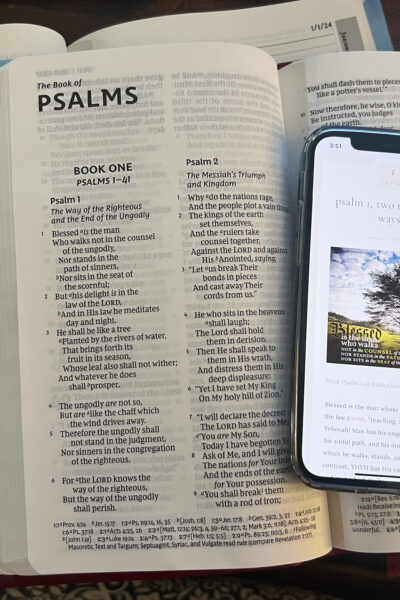
Today I’m going to start a study in Psalm 1, since it’s my favorite one.  I’m planning to take this Psalm one verse at a time, so hopefully these Bible studies won’t be as long that way.  Since we’re going slow, you’ll have time to memorize the Psalm if you do one verse a week.  I always recommend writing out the verse on a 3″x5″ card or small slip of paper and hanging it over your kitchen sink.  In no time at all, you’ll know it by heart!

Okay, let’s take a look at Psalm 1:1…

Blessed is the man
who does not walk in the counsel of the wicked
or stand in the way of sinners
or sit in the seat of mockers.

I absolutely love this Psalm, probably because it has had such an impact on my own life.  I tell this story in my Juggling Life’s Responsibilities book, but here’s the short form.  Back in the fall of 1995, when I was pregnant with my first baby, I began to panic when I realized how little I knew about babies!  Yikes!  I had babysat a little during high school, but those children were toddlers or older.  I had only held a newborn once in my life, and that had been the spring before, at a ladies’ Bible study, when one of the women brought her two-week-old son.  Since everyone knew I was pregnant, they all passed the baby to me to hold.  It was fun, but I felt so awkward, and all I could do was make him cry.  The mom kindly let me bungle my way through for 20 minutes or so, and even then, I could feel the muscles in my arms for two days!  What was I going to do when I had my OWN baby?!

We moved to a small town that summer, a retirement town in Florida.  Every Friday morning I attended a craft class at our church so that I could fellowship with other women.  But these women were so much OLDER than me! They freely gave me lots of parenting advice, whether I wanted it or not. Usually I didn’t want it, but I’d smile politely.  Inside I was thinking, “Don’t they know how old-fashioned they are?  Don’t they realize how crazy they sound?”

To help make ends meet, I worked a part-time job in a nearby city.  After work in the afternoon, I had time to stop by a nice library.  Almost daily I would visit the parenting section and devour the advice given.  I realized that most of the books were written by non-Christian authors, but I also reasoned that I had been a Christian long enough to tell if their advice was biblical or not.

Well, I was wrong!  Little Arik was born in November, and the few months following were the hardest of my life.  My husband and I argued over parenting methods, and since he was working a middle-of-the-night shift and sleeping much of the day, I figured I could do what I wanted without his knowing.  My mom lived nearby, but I felt funny sharing my library-book opinions with her.  And there was no way I was going to talk about my problems with those old women at church!

I wasn’t “blessed.”  “Blessed” simply means “happy,” but I certainly wasn’t happy!

Near the end of January 1996, I met a godly woman in a chat room online. She didn’t preach at me or try to change me.  She simply let me talk, then encouraged me to read Psalm 1.  I hadn’t been doing too much Bible reading (blaming it on the newborn taking up too much of my time?), but I felt like God was talking directly to me in verse one.

Matthew Henry has this to say in his Bible commentary:

“This is a psalm of instruction concerning good and evil, setting before us life and death, the blessing and the curse, that we may take the right way which leads to happiness and avoid that which will certainly end in our misery and ruin.”

This kind woman also recommended a book to me, which I promptly bought and read.  I immediately noticed a difference in this book.  It didn’t talk about evolution.  It wasn’t full of psychology.  It wasn’t just a collection of mother’s experiences.  It was firmly based upon the Word of God.  And it rescued our family!

I remember the day as clearly as if it were yesterday.  I was sitting in my living room in the afternoon.  It was sunny.  And I couldn’t get the words of Psalm 1:1 out of my head.

You see, I had started out by just getting simple counsel from the ungodly. Oh, their advice wasn’t always so bad.  But I never bothered to check the source, to see if their own lives acknowledged the one, true God.  It was a small step in a very bad direction.

Then I started to stand with them, to stick up for them in front of others. I started quoting Scripture verses that would make me feel better, even if taken out of context.  My core philosophies of life began to change, but I wasn’t even aware of it.

By the time Arik was born, I was sitting with the scornful.  I made fun of anyone who was “old-fashioned” enough to follow biblical advice.  I was a committed Christian on the outside, but I was an atheist in practice.  I was rebellious.

And God didn’t bless.

You know, I later found out that those wise women at craft class were right. I suspect they knew I was headed down the wrong path, and they were blunt enough to try to help me.  But my mind was not open to God, even though I would never have admitted it.

The Lord is gracious, isn’t He?  Next week we’ll talk about God’s solution to the world’s wisdom, and I’ll share how my online friend guided me along right paths.

I’m sorry for being so long, especially after I said I’d be short!  But I’m hoping that there is a woman out there who will take the words of this Psalm to heart and allow God to bless her, maybe simply because I shared some of my story.

P.S. Are you curious who that wise woman was? (Hint: She shares my name.) What book did she recommend?

Author: Anne Elliott
• Friday, March 12th, 2010

When I was in high school, I had the privilege of taking a “how to teach” class from one of our school’s elementary teachers. I took the class because I was considering majoring in elementary education in college, so I wanted to see if I would like it or not. My teacher was one of those ladies that has a lot of “with-it”-ness in her teaching. She made her classes interesting. Her students loved her. She was in control in the classroom, with a certain degree of strictness, yet she really cared about each student and made sure that they were all learning.

For those of us high school students who took her class, she used as her text the classic book by John Milton Gregory, the Seven Laws of Teaching. Lately I was thinking about that book and wishing I could see it, since not only am I a mother of seven but I’m my children’s school teacher as well. How excited I was to find out that the Seven Laws of Teaching can be read for free on Google books!

I have a similar book on my shelf by Howard Hendricks, called The Seven Laws of the Teacher. I bought this book in college, in a class for educational psychology. I’m not a big fan of psycho-babble psychology, but our professor was one of those teachers who changed my life, probably because he really “got” what Dr. Hendricks was saying in his book.

As homeschooling mothers, are we great teachers? Do we work hard to not only provide our children with good curriculum but also to diligently teach our children effectively?

Sometimes when I’m at church, around young children, I’m very careful to smile, to hug, and to be interested in what they’re saying. Yet when I get home around my own kids, I’m too tired to smile, to busy to hug, and too disinterested to listen to their jabbering. God has been convicting me that I need to give the best I have to my own children.

“You shall teach them diligently to your children, and shall talk of them when you sit in your house, and when you walk by the way, and when you lie down, and when you rise” (Deuteronomy 6:7, ESV).

God is very clear that we are to teach our children diligently. The Hebrew word for “diligently teach” means to pierce, to poke, and to infiltrate. What strategies can we use to be sure that the things we’re teaching our children sink deeply into their hearts?

The first law of the teacher, both Milton and Hendricks agree, is that a teacher can’t teach what she doesn’t know.

“The teacher must know that which he would teach…. Imperfect knowing must be reflected in imperfect teaching.” - John Milton Gregory

“If you stop growing today, you stop teaching tomorrow.” - Howard Hendricks

Yes, you’re a mother, and that means you have a lot of work in the house to do (dishes, laundry, bills to pay, errands to run), but especially if you’re homeschooling, you have a huge responsibility for the quality of your teaching.

“…Everyone who is fully trained will be like his teacher” (Luke 6:40).

Isn’t that a convicting thought? My children, when they are grown, will be like me. (Yikes…)

“I would rather have my students drink from a running stream than a stagnant pool.” - Howard Hendricks

As you think about your own growth as a learner, here are some things to consider:

  1. What am I passionate about? How can I take these passions and relate them to the things I’m teaching?
  2. How well do I know the subjects I’m teaching? If I don’t know them well, what I am doing to change that?
  3. How can my love for learning awaken a love for learning in my students?

Howard Hendricks shares this story of an 86-year-old woman:

The last time I saw her on planet earth was at one of those aseptic Christian parties. We were sitting there on eggshells, looking pious, when she walked in and said, ‘Well, Hendricks, I haven’t seen you for a long time. What are the five best books you’ve read in the past year?’

She had a way of changing a group’s dynamics. Her philosophy was, Let’s not bore each other with each other; let’s get into a discussion, and if we can’t find anything to discuss, let’s get into an argument.

She was eighty-three on her last trip to the Holy Land. She went there with a group of NFL football players. One of my most vivid memories of her is seeing her out front yelling back to them, ‘Come on, men, get with it!’

She died in her sleep at her daughter’s home in Dallas. Her daughter told me that just before she died, she had written out her goals for the next ten years.

Some “rules” for developing yourself as a teacher, paraphrased from Milton’s book are:

  1. Study fresh. Did you teach phonics two years ago? Take some time to “freshen up” your mind before you teach it again. Has it been 21 years since you took Algebra I? You probably need some review!
  2. Relate the known to the unknown. What do you already know a lot about? How can you make connections in your brain to the new information?
  3. Study until you can rephrase it clearly. Knowing something well means that you can put it in your own words.
  4. Find the natural order. Anything makes more sense when it’s in order. When you’ve got a recipe in order in your mind, you do a better job cooking it, right?
  5. Make it practical. How have you used fractions in real life? Why did you need to learn geography?
  6. Don’t stop trying until you really understand. Don’t give up when you’re only halfway. Take the time to make sure you’re comprehending completely.
  7. Set aside the time you need for study. Learning takes time. It doesn’t happen by osmosis, by placing books under your pillow. You need time in your life to grow, to read, to reflect. Build some margin for self-education into your schedule.
  8. Use the “six serving men.” That’s what one of my teachers called these questions, which you should ask of yourself when learning something new: Who? What? When? Where? Why? How?
  9. Read widely. Find the best scholars on a topic and read what they’ve written.
  10. Discuss with others. Whether by email or in person, you will learn better what you’ve talked about with others.

Moms, are you still growing? Are you growing intellectually, physically, socially, and spiritually (see Luke 2:52). Beware of being too tired to care, too busy to invest, and too bored to discover.

P.S. What are the five best books YOU’VE read in the last year?

Author: Anne Elliott
• Friday, March 12th, 2010

Note: I have over 20 questions about adrenal fatigue sitting in my email inbox, asked by visitors to Anne’s Health Place. So starting today, I’m going to do my best to answer these questions, one each week. If you’d like to ask a specific question about adrenal fatigue, click here.

Is it true that once the adrenals are “used up” that they are gone and your body can’t replenish?

This is a question I ask myself almost daily. Can organs of the body heal? What is the definition of healing anyway? How do we know if we’re better? (And more importantly, will I have to cope with chronic fatigue for the rest of my life… or someday, will this all be a distant memory?)

That I ask myself this question so often should tell you something of my answer.

I just don’t know the answer. :-)

Here are some opinions, though.

If you are “catching” adrenal fatigue early, you are more likely to make a full recovery. However, if your adrenals get so bad that they aren’t functioning much at all any more (and you’d know this because you’d either be dead or on a prescription to replace the hormones that your glands aren’t making), then I’m not sure how much you can recover.

One visitor wrote to me,

“I do not believe Addison’s disease is incurable.”

Well, I’d love to agree with her, but I’m not sure I do. You see, the definition of Addison’s disease is that at least 90 percent of your adrenal cortex has been destroyed (source). There is no documentation anywhere that the adrenal glands can regrow, like the liver can. If my hand were chopped off, could it regrow?

However, at least a portion of the adrenal cortex is probably still working, for if Addison’s disease were discovered when 100 percent of the gland was destroyed, then the poor patient would be dead! So the question might better be, Can a person function with good health on less than 10 percent of the adrenal cortex? This would be similar to asking if a person can function with good health on a partially damaged kidney or heart.

Yes, I believe that this might be possible! Again, the sooner the problem is caught, the less damage would have occurred and the easier it would be to recover.

I have listed steps to recovery from adrenal fatigue previously on my blog, as well as on Anne’s Health Place, so I won’t go over those again today. Just keep in mind that the worse the damage is, the more strict you’d obviously have to be to function with good health.

So can the adrenal gland be healed? I’m not sure. I don’t think any scientists know this either. Most doctors will tell you it’s impossible. Some alternative physicians may propose that it could happen. I just don’t know.

I’d sure like to think so! I DO know that it’s possible to live a good life, with occasional bumps in the road, even with a chronic disease. I also know that the Bible says I’ll die someday, no matter what I do to try to prevent it. I know that God is able to miraculously heal — although He doesn’t always choose to do so. Finally, I know that I can prevent some of these serious health problems in my children and grandchildren, so this is a great place to expend some of my energy.

The jury will remain out on this one. Ask me again in another 40 years. I might have more wisdom then.

Author: Anne Elliott
• Wednesday, March 10th, 2010

A friend of mine was just commenting that maybe we should team up to visit some homeschooling conferences this summer. We have 13 children between us, so we thought one mom could stay home and babysit, while the other attended a conference and took copious notes. Then we could switch for the next conference.

That really didn’t sound so great. :-)

That’s why I love online conferences. I think maybe my friend and I could even meet at each others’ homes and let the children play together while we sit in front of the computer together. We could chat with other moms AND with each other, yet there would be no travel time, no babysitters, no hotel or food bills. It would be almost perfect!

So I’ve been watching for upcoming conferences. Here are some that I’ve heard about so far, and I’ll be sure to update you when I hear of more:

Enjoy!

Author: Anne Elliott
• Monday, March 08th, 2010

I’ve been working on a “philosophy” of health and nutrition to post on Anne’s Health Place. Here is my first draft, and I’d love comments from you. Am I missing anything? Is anything worded too vaguely? (I’m not thinking that everyone will agree with all these points… and that’s okay! But is it clear? Easy to understand?) Thanks so much for your input!

<< clipped from http://www.anneshealthplace.com/philosophy.shtml >>

When you visit a health website, it’s nice to quickly find out what the author believes, so you can see if it’s a good fit for your style or not. Let’s face it… we’re not all the same, are we? Your family won’t have exactly the same health beliefs as mine, but you’re searching for information. You’re willing to grow and learn new things, right? Same here.

Here are the basic beliefs that we base our decisions on in our home:

  • We believe in a Creator God, and we believe in the Bible as God’s revealed will for us. If you’re not a believer, you’re still welcome here — but we thought you’d want to know that we don’t believe in evolution and other non-biblical things here.
  • We believe God made green plants for our food and good health (Genesis 1:29-30). When those green plants still have their God-given enzymes and nutrients in them, they will be healthier for us. For that reason, we try to eat a lot of “raw” foods that still have enzymes in them.
  • We also believe that some green plants are just easier for our bodies to digest when they’re cooked, so we eat a lot of soups and cooked veggies in our home. Since we don’t believe that man evolved over many years but rather were created on the sixth day by God (and were intelligent enough to have fire, became farmers immediately, etc.), cooking is okay with us.
  • We’re not vegetarians. Eating only plants has its place (maybe for short-term health reasons), but we believe that God directed mankind to eat animals for our protection and benefit after the global flood of Noah’s time (which, of course, we believe was a true, historical event). So we eat animal products in our home, for our health.
  • We believe that the entire Bible is for our benefit and instruction, not just certain portions. Therefore, when God told Noah (and later, Israel, and later, the church) not to eat unclean meat with the lifeblood still in it, we believe that was for their health and benefit. That’s why we don’t eat pork, shellfish, and other “unclean” foods that scavenge and eat blood.
  • We try to eat food in a form that is as close to how God created it as possible. That means we try to avoid factory-produced food, opting instead for making as much of our food from scratch as we can. While we’re NOT perfect in this (and you need to know that, in case you should ever visit), it’s a goal we’re constantly working towards.
  • Our final point? We aren’t perfect! We’re sinners, imperfect, and bumbling idiots on many days. That’s why we still get sick and will eventually die. It would be wonderful to live to be hundreds of years old, wouldn’t it? But rather than making immortality our goal, we’re striving instead to have as good of a quality of life as we can for the years that our God will give us, so that we can serve Him, living with thanksgiving, love, and joy — and being okay with it if God should decide to take us home earlier than we liked. Only through the redemption that is in our Savior Jesus Christ can we have that peace and joy. Our satisfaction comes through Him, not in our own ability to eat right or try to reach other forms of self-fulfillment.

That sums it up, as best as we can. Read more about the steps we’ve taken for good health here.

<< End of clip >>

Author: Anne Elliott
• Friday, March 05th, 2010

My ezine is online this week, rather than hosted here on my blog. You can only view it for a few weeks, then it will disappear, but it’s got some great stuff. I went through each of my websites and compiled the best articles from the last eleven years. The topic is parenting, and I think you’ll love it.

>> Click here to view it.

Also, in honor of the publication of our book, The Four Foundations of Lifelong Learning: Preparing Your Little Ones for School, all of our printed books and curriculum will be on sale for the entire month of March! This includes all of our Bible curriculum and P.E. curriculum. Enjoy!

To receive your discount, be sure to enter coupon code “IDES” at checkout.*


*Disclaimer: Enter coupon code ‘ IDES ‘ during checkout and save 10% off the purchase price. Discount cannot be used to pay for, nor shall be applied to, applicable taxes or shipping and handling charges. Maximum amount that may be applied to discount is $10.00 per account. Promotional codes cannot be applied to any previous orders. No exchanges or substitutions allowed. Only one valid promotional code may be used per order. Offer expires March 31, 2010 at 11:59 PM EDT. Lulu.com reserves the right to change or revoke this offer at any time. Void where prohibited.
Offer Expires: March 31, 2010

Author: Anne Elliott
• Friday, February 26th, 2010

“Remember them which have the rule over you, who have spoken unto you the word of God: whose faith follow, considering the end of their conversation” (Hebrews 13:7, KJV).

I had a fun week in homeschooling, a monumental week really. My children and I got a school room of our own! For 9 years of school, we’ve been using the dining room as our “school room,” which is fine — but my husband is so neat and tidy (and I’m not naturally so at all), so it’s always a struggle to return the dining room back to its original purpose at the end of each day. In addition, I have always wished for a place to hang a white board, maps, charts, and other “schoolish” things. Maybe not all mothers feel this way, but it’s always been a secret desire of mine. (Again, I love our decor, but it is sometimes hard to teach in an environment of pretty things in… well… a dining room!)

But I digress…

Now we have a room dedicated just to school time. One of my favorite things is indeed hanging teaching aids on the walls. We were listening to an audio by Andrew Pudewa, of the Institute for Excellence in Writing, where he describes many of the values of having visual aids on the walls to help with memorization.

One of the devices we’ve been using is to make charts of various mnemonic devices. The word mnemonic is Greek and means “to continually remember.” For instance, my son in algebra learned the mnemonic device “FOIL” for multiplying binomials. FOIL stands for First, Outer, Inner, Last — a way to remember which factors to multiply when.

In case you think I’ve completely forgotten our text for today, don’t worry. Mnemonic comes from the same Greek word as the one in our verse. Mnemoneuo or remember.

“Remember them which have the rule over you…”

I’ve always thought that this verse was talking about honoring my pastor or deacons. Later in Hebrews 13, we’ll read some verses that talk about ways to honor our leaders, but most commentators make the argument that the rulers mentioned in this verse are past rulers.

“Remember those who led you…” (NASB)

“Remember your former leaders…” (GNB)

One of the things we’ve been memorizing in our homeschool is the information on the front of the Veritas Press history cards, learning eight cards each week, as a framework of sorts to “hang” all our other history learning on. As mnemonic devices, or memory aids, they bring to our mind those Christian leaders who have gone before us. We remember the faith of John Knox of Scotland, for instance, and we learn about the people to whom he spoke the Word of God. We remember the faith of Calvin, Martin Luther — and even Abraham — and we remember that we are to follow their faith.

And what more shall I say? I do not have time to tell about Gideon, Barak, Samson, Jephthah, David, Samuel and the prophets, who through faith conquered kingdoms, administered justice, and gained what was promised; who shut the mouths of lions, quenched the fury of the flames, and escaped the edge of the sword; whose weakness was turned to strength; and who became powerful in battle and routed foreign armies. Women received back their dead, raised to life again. Others were tortured and refused to be released, so that they might gain a better resurrection. Some faced jeers and flogging, while still others were chained and put in prison. They were stoned; they were sawed in two; they were put to death by the sword. They went about in sheepskins and goatskins, destitute, persecuted and mistreated— the world was not worthy of them. They wandered in deserts and mountains, and in caves and holes in the ground” (Hebrews 11:23-38, NIV).

One of our wall charts talks about kinds of verbs, and I can see two verbs in today’s verse: “Remember” and “follow.”

  1. Remember — (“Remember them which have the rule over you, who have spoken unto you the word of God…”) The words “have spoken” here aren’t referring to a sermon that is systematically and carefully arranged and delivered. They also aren’t referring to a single word, a hint of the gospel too casually mentioned on very rare occasions. Rather, “have spoken” is talking about an extended conversation that is characterized by strong emotions. Who is the leader who passionately argued in favor of the gospel with you, leading you to faith in God. Was it your mother and father? What about all the leaders who, down through the centuries, were so passionate for “Word of God” that they even gave their lives? How does their influence live on? Do we know? Do we even care?! And what mnemonic devices have we used to help us carefully remember them?
  2. Follow — (”…whose faith follow, considering the end of their conversation”) Why are we to so carefully remember our leaders, those who spoke to us the word of God? Because we are to follow in their footsteps. The word “conversation” in the King James Version means “behavior.” The “end” of their behavior is probably referring to the end of their lives, sometimes even in martyrdom. They were faithful to the literal end, when their physical lives were extinguished because of their consistent behavior. More sobering to me, though, is that the word “follow” doesn’t mean I should follow distantly in the shadows, hoping no one will see me (as Peter did at the trial of Jesus), but that I should “mimic” them, as Peter did at the end of his life, when tradition tells us he was crucified as Jesus was.

Who are your spiritual heroes? While we are to worship only God, we are told to “consider” (to stare intently at) the “behavior” and faith of those who have gone before us. They weren’t perfect people, but they were characterized by faith, by seeing the unseen and trusting the unseen God.

Therefore, since we are surrounded by such a great cloud of witnesses, let us throw off everything that hinders and the sin that so easily entangles, and let us run with perseverance the race marked out for us” (Hebrews 12:1, NIV).

As mothers, we need to remember those who have gone before us, following their faith and godly behavior. We need concrete memory devices to help us do that, whether it be the study of the lives of great men and women in the Bible, in the pages of history, or in biographies and autobiographies.

Finally we need to follow their faith because little eyes are watching OUR faith! They are checking to see if our behavior will endure to the ends of our lives. Do we believe what we believe — enough to keep believing it until the end?

…he who doubts is like a wave of the sea, blown and tossed by the wind. That man should not think he will receive anything from the Lord; he is a double-minded man, unstable in all he does” (James 1:6-8, NIV).

So I really did have a fun week in homeschooling. All my memory devices are neatly stored in wicker baskets on a shelf or hung up on the walls. As we study geography, our Latin verbs and Greek roots, our history cards, our Bible stories, and and our key-word outlines, I’m hoping that we’ll all remember why we’re studying so hard. May the seeds we plant during our school days bloom into strong plants that have the faith to endure until death, walking by faith.

Author: Anne Elliott
• Friday, February 26th, 2010

If you’ve been following along again with our health classes, you’ll know that we’re at the end of our 8 sessions. In this last class, we take two full hours to tackle some of the most common health questions.

  • What do I do if my family won’t eat better without a fight? I can fix the right stuff (oatmeal, whole wheat bread, veggie meals), but they won’t touch it or just complain — so I don’t try.
  • How does exercise play a role in good health? I just don’t have enough energy to exercise.
  • I weighed 140 pounds in high school. In 15 years I’ve gained enough weight that now I weigh over 300 pounds, and I don’t know where to start.
  • What do I do if I’m eating things just because I’m emotionally upset?
  • I’m allergic to everything, and it makes me miserable. What can I do? (Specifically, I have gluten sensitivity, chemical sensitivity, and seasonal allergies.)
  • What do I do about vitiligo?
  • What do I do about snoring?
  • I’ve tried every diet there is … Maybe I haven’t given it enough time to change my body, but one would think I’d see more progress if I’m doing it right. Is something off balance? maybe thyroid?
  • How do you find the right doctor or encourage your doctor to look for more answers before prescribing a drug?
  • I was wondering about serving sizes, like how do I find out what a normal serving size is? My children eat as much as I do. Is that okay as long as it is healthy food?

There were many more questions answered over the course of the two hours, since this was a live call and guests could ask anything they wanted. It was a lot of fun! Click here to listen!

I’d love to hear your feedback from these classes. What could I do to improve them or make them more practical? What would you change? How have you been helped?

Thanks!

Author: Anne Elliott
• Friday, February 26th, 2010

I found the following great links online this week, and I couldn’t help but share. Here they are, in no particular order:

  • Telephone Rules — Have you ever thought about how much easier it is for classroom teachers to actually get a lesson done, without the phone ringing off the hook all day? No one is allowed to interrupt class unless it’s an emergency. In this article, Janice Campbell shares her rules for homeschooling with the telephone.
  • Flirting 101 (for Married Women) — Married women should flirt — but only with their own husbands (of course!) Here are some fun ways to win the heart of your husband.
  • Freedom in Following Rules — Many say that we are free in Christ, so free that we never have to obey any rules at all. Is this true? This author shares how God’s “rules” give freedom, just as the rules of a board game help us better enjoy the game.
  • Coconut Recipes — I’m always on the look-out for more ways to get coconut into our diet, yet coconut is starting to feel a little boring to me. (Honestly, I was just thinking that this morning!) So I was excited to discover this page of recipes from Tropical Traditions, an excellent supplier of coconut oil.

Author: Anne Elliott
• Friday, February 19th, 2010

I never dreamed how many topics could come out of one little Bible passage, but this week’s certainly had a lot of them! I wasn’t sure what to write about. Too many good possibilities here!

But I’m going to try to be as practical as possible. (If you want some of the deeper topics, just dig in. There’s a lot of treasure in these verses, if you’ll mine for it.)

As a review, though, we learned that “faith is being sure of what we hope for and certain of what we do not see” (Hebrews 11:1). Faith is living my life in light of things that haven’t happened, that are in the future, and that I can’t see.

Today we read,

“Keep your lives free from the love of money and be content with what you have, because God has said,
‘Never will I leave you; never will I forsake you.’

So we say with confidence,
‘The Lord is my helper; I will not be afraid. What can man do to me?’
” (Hebrews 13:5-6).

Faith doesn’t look at material possessions; rather, faith looks at our Spiritual Provider.

God’s Provision

We are told to keep our lives free from the love of money. In Matthew 6, Jesus tells us that we can love money (the Hebrew word is “mammon”), or we can love God — but we can’t love both. We can either depend on earthly treasures to supply our needs, or we can depend on God to supply — but we can’t trust both.

We often forget that when we store up our treasures here on earth, our treasures can very quickly be lost. Moth and rust can destroy. Thieves can break in and steal.

Our pursuit of money, and the security that we think it will bring, becomes idol worship.

“They exchanged the truth of God for a lie, and worshiped and served created things rather than the Creator” (Romans 1:25).

Faith sees what can’t be seen, which is God’s faithful provision for all our needs. He feeds us. He clothes us.

“I was young and now I am old,
yet I have never seen the righteous forsaken
or their children begging bread”
(Psalm 37:25).

So let’s get practical for a moment. When we worry, are we worshiping and serving created things rather than the Creator? We may say that we recognize God is our provider, but to prove that, we have to stop worrying.

“Unless the LORD builds the house,
its builders labor in vain.
Unless the LORD watches over the city,
the watchmen stand guard in vain.

In vain you rise early
and stay up late,
toiling for food to eat—
for he grants sleep to those he loves
” (Psalm 127:1-2).

God’s Presence

God provides for our needs, but He goes even further and provides us with His very presence. The author of Hebrews quotes from the Old Testament here with God’s statement that “Never will I leave you; never will I forsake you” (Hebrews 13:5).

This is truly an amazing promise! When God gave this promise to Joshua and the children of Israel as they were about to enter the Promised Land, they believed Him — long enough to conquer the city of Jericho. Oh, except for Achan, who forgot that God would never leave or forsake him… and so he stole some gold from the city… even though God had told them not to… but he forgot God was with Him… so he didn’t obey… then he was surprised when he was caught….

Hmmm. Do I ever forget that God will never leave or forsake me?

I’m quite happy He’s with me… when I’m having a problem, or I want a quick answer to prayer, or I want to get all emotionally wrapped up in my religious experiences.

It’s not as convenient to have an ever-present God when I don’t feel like obeying Him.

“Praise be to the LORD, who has given rest to his people Israel just as he promised. Not one word has failed of all the good promises he gave through his servant Moses. May the LORD our God be with us as he was with our fathers; may he never leave us nor forsake us. May he turn our hearts to him, to walk in all his ways and to keep the commands, decrees and regulations he gave our fathers. And may these words of mine, which I have prayed before the LORD, be near to the LORD our God day and night, that he may uphold the cause of his servant and the cause of his people Israel according to each day’s need, so that all the peoples of the earth may know that the LORD is God and that there is no other. But your hearts must be fully committed to the LORD our God, to live by his decrees and obey his commands, as at this time” (1 Kings 8:56-61).

So which shows more faith? Prayer and religious experiences… or obedience to my Heavenly Father’s commands?

God’s Power

The hardest part for me is remembering God’s power. I start looking around at the power of man, and then I start to get afraid. I start to think of all the things that people could do to me, might say about me, might think of me. I’m sorry to say that it’s rare indeed that I “say with confidence, ‘The Lord is my helper; I will not be afraid. What can man do to me?‘” (Hebrews 13:6).

(Well, I might say it — but probably not with too much confidence!)

These verses are a quotation from Psalm 118, where the Psalmist wisely tells us,

It is better to take refuge in the LORD
than to trust in man
” (Ps. 118:8).

Faith sees what can’t be seen. It sees YHWH’s power, His presence, and His provision, and it takes refuge in Him.

I mean really, what can man do to me? I suppose my husband could lose his job… but Who has promised to always feed and clothe me? I suppose I could get sick, but Who gives me breath so that I can praise Him? I suppose someone could persecute me because of my faith, but Who has promised to give me life at the last day? I mean really, what can man do to me?

If you’re ever tempted to skip reading the Bible verses on blogs, don’t skip these. They’re good enough to believe!

And we know that in all things God works for the good of those who love him, who have been called according to his purpose. For those God foreknew he also predestined to be conformed to the likeness of his Son, that he might be the firstborn among many brothers. And those he predestined, he also called; those he called, he also justified; those he justified, he also glorified.

What, then, shall we say in response to this? If God is for us, who can be against us? He who did not spare his own Son, but gave him up for us all—how will he not also, along with him, graciously give us all things? Who will bring any charge against those whom God has chosen? It is God who justifies. Who is he that condemns? Christ Jesus, who died—more than that, who was raised to life—is at the right hand of God and is also interceding for us. Who shall separate us from the love of Christ? Shall trouble or hardship or persecution or famine or nakedness or danger or sword? As it is written:

‘For your sake we face death all day long;
we are considered as sheep to be slaughtered.’

No, in all these things we are more than conquerors through him who loved us. For I am convinced that neither death nor life, neither angels nor demons, neither the present nor the future, nor any powers, neither height nor depth, nor anything else in all creation, will be able to separate us from the love of God that is in Christ Jesus our Lord” (Romans 8:28-39).

Those are shouting words! Hallelujah!

If we’ll just have faith to see what we can’t see.

Category: Hebrews  | 4 Comments